UDS Full Form and Meaning: What Every Bangalore Flat Buyer Should Know

Real Estate Basics
- September 7, 2026
- 14 min read
Introduction
What Is UDS in Real Estate?
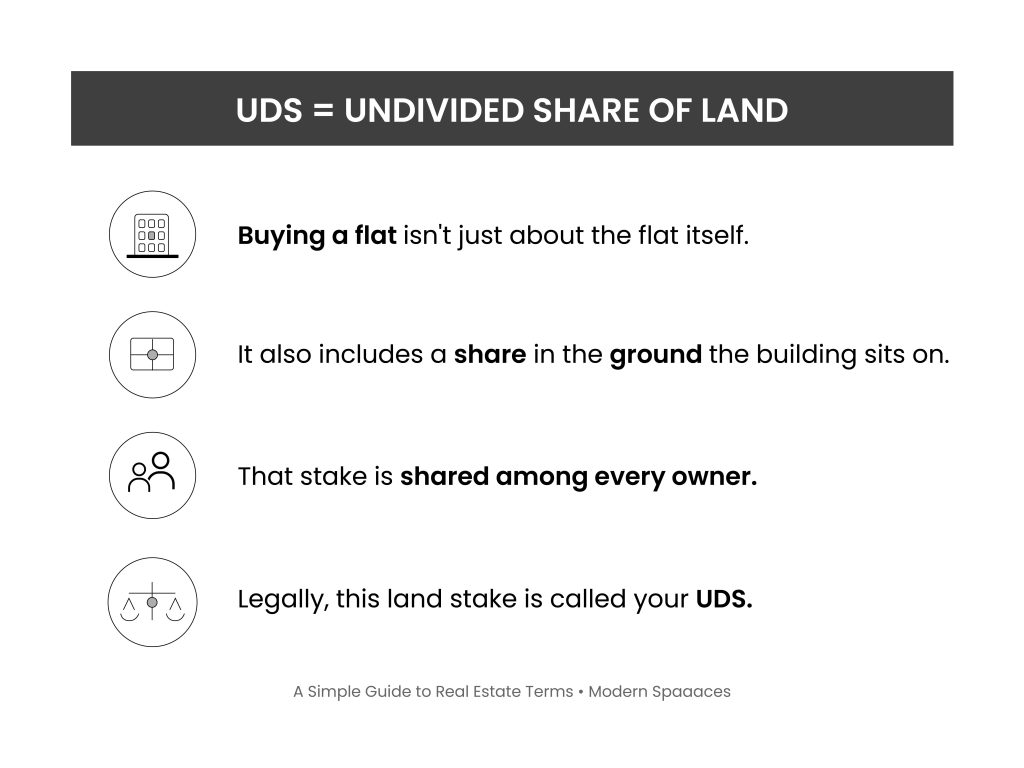
UDS stands for Undivided Share of Land. It is the proportionate share of the land on which an apartment building is constructed that legally belongs to each flat owner.
When you purchase an apartment, you are not only buying the constructed space. You are also acquiring a share of the land on which the project stands. This land share is known as UDS or Undivided Share of Land.
UDS matters because it can affect your property ownership, resale value, redevelopment entitlement and, depending on the applicable rules or association documents, certain common-property or voting matters.
Key Takeaways: What You Should Know About UDS
- UDS stands for Undivided Share of Land and represents your proportionate ownership in the land on which an apartment project is built.
- UDS is different from carpet area and super built-up area. While these refer to the size of your apartment, UDS refers to your share of the underlying land.
- UDS calculation is generally based on the apartment’s proportionate share in the total land area, subject to the project’s legal structure and documents.
- UDS can be important during property resale, redevelopment, inheritance and other ownership-related matters.
- Always verify the UDS mentioned in the sale deed and other title documents before property registration.
- When comparing apartments, consider the UDS along with carpet area, super built-up area, price and other property details.
- Check the applicable RERA disclosures and project documentation to understand the ownership and common-area details associated with the apartment.
- In simple terms, UDS tells you how much of the land associated with an apartment you proportionately own, in addition to owning the apartment itself.
What Does UDS Mean? Understanding Undivided Share of Land
UDS means Undivided Share of Land. It represents the proportionate share of the total land in an apartment project that belongs to an individual flat owner.
The word “undivided” is important. It means your share cannot normally be physically separated or marked out as a particular section of land.
For example, if an apartment project is constructed on a 10,000 sq. ft. plot, the entire land is collectively owned by the apartment owners according to their respective shares. You do not own a specific physical portion of the plot, such as the land below your bedroom or parking area. Instead, you own an undivided share of the entire plot.
Your UDS is generally recorded in the relevant property documents, including the registered sale deed, and should be checked carefully before purchasing a flat.
Why Is UDS Important?
A flat purchase is therefore more than the purchase of four walls and a roof. Your ownership generally consists of:
Apartment + proportionate undivided share in the land
While the building can depreciate over time due to age and wear, land is a separate component of the property’s long-term value. This makes understanding your UDS particularly important when evaluating a property for purchase, resale or future redevelopment.
How Is UDS Calculated?
A commonly used method for calculating UDS is:
UDS = (Your apartment’s super built-up area ÷ Total super built-up area of the project) × Total land area
How to calculate UDS for Bangalore Apartments?
Suppose:
- Total land area = 5,000 sq. ft.
- Total super built-up area of the project = 10,900 sq. ft.
- Your apartment’s super built-up area = 1,500 sq. ft.
The calculation would be:
UDS = (1,500 ÷ 10,900) × 5,000
UDS ≈ 688 sq. ft.
Therefore, the flat would have an approximate UDS of 688 sq. ft.
However, the exact method and figures used for determining UDS can vary depending on the project’s structure, unit configuration, development approvals and legal documentation.
Does a Larger Flat Always Have a Higher UDS?
Not necessarily in absolute terms, but in many projects, UDS is allocated proportionately to the apartment’s area.
For example, a 2,000 sq. ft. apartment in the same project may have a greater UDS than a 1,000 sq. ft. apartment because its proportionate share of the project’s total saleable area is larger.
The important factor is not simply the size of your apartment but how its share is calculated against the total project land and applicable unit areas.
UDS vs Carpet Area vs Super Built-Up Area
These three terms refer to different components of a property and should not be used interchangeably.
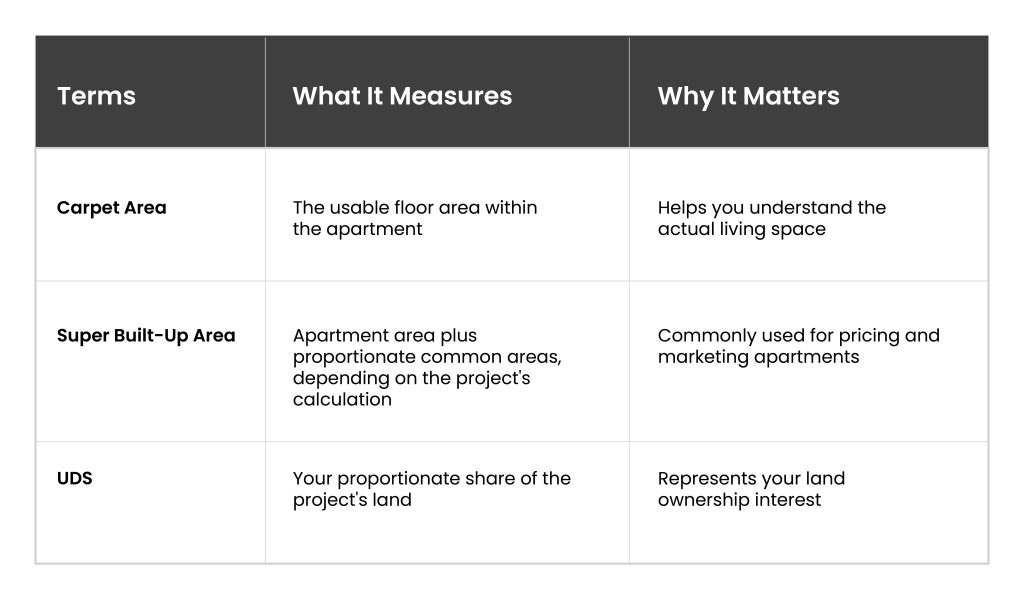
In Simple Terms
Carpet area = How much usable space you have
Super built-up area = The area used to describe the apartment along with its proportionate share of common areas
UDS = How much of the project’s land you legally own
UDS in Key Property Scenarios
Understanding Undivided Share of Land (UDS) is important when buying, selling, inheriting or redeveloping a property. Your UDS represents your proportionate ownership in the land on which the property is built and can have practical implications in several situations.
How Does UDS Apply in Multi-Tower Apartment Projects?
In large residential developments with multiple towers, each apartment owner is assigned a proportionate share of the underlying land. This is known as the Undivided Share of Land (UDS).
Your UDS is linked to your apartment and represents your ownership interest in the land and, where applicable, your share in common areas and facilities. Gardens, internal roads and other common spaces are generally shared by residents and are not individually divided among apartment owners.
Why Is UDS Important During Redevelopment?
If a residential property undergoes redevelopment, the UDS can become an important factor in determining an owner’s interest in the underlying land.
A higher UDS may mean a larger proportionate interest in the land, which can be relevant when determining redevelopment entitlements, subject to the applicable agreements, laws and redevelopment terms.
What Happens to UDS During Inheritance or Resale?
UDS forms part of the ownership associated with the property and is generally transferred along with the apartment. When a property is sold, gifted or inherited, the relevant property documents should clearly establish the owner’s share of the land.
Before buying or selling an apartment, homebuyers should therefore check the UDS mentioned in the sale agreement, sale deed and title documents.
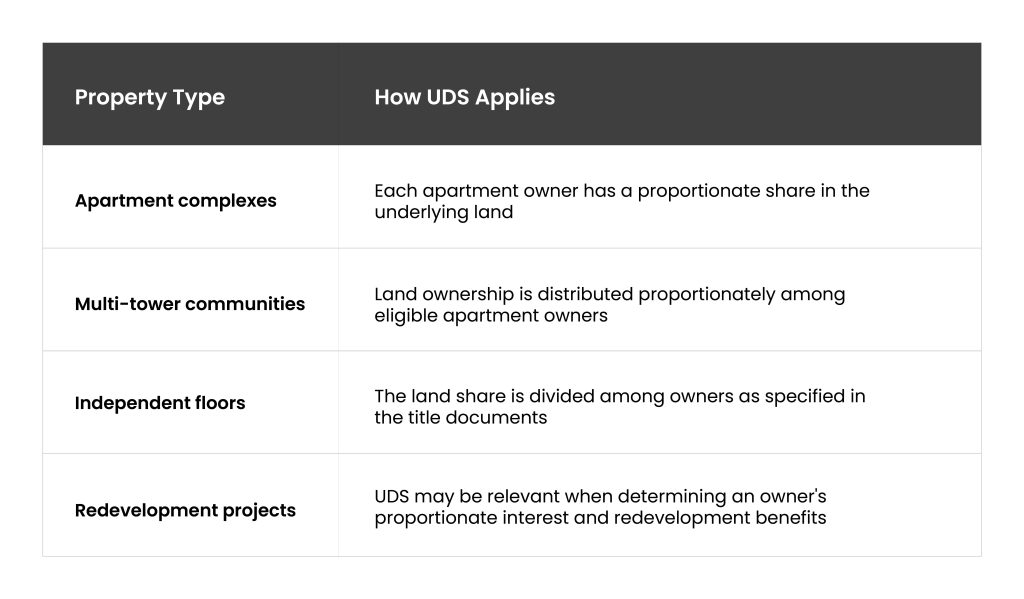
How Does UDS Apply to Different Property Types?
What Does RERA Say About UDS?
Under the Real Estate (Regulation and Development) Act, 2016 (RERA), homebuyers should receive clear information about the apartment, project and their rights relating to common areas and facilities.
For an apartment purchase, the agreement for sale and sale deed should clearly record the relevant property and ownership details, including the buyer’s undivided share of land where applicable.
Why Should Homebuyers Check Their UDS?
Checking your UDS before purchasing an apartment can help you:
- Understand your proportionate ownership of the land
- Verify the details stated in the sale agreement and sale deed
- Avoid ambiguity during resale or inheritance
- Understand your potential interest in future redevelopment
- Compare the land component of different apartment properties
In short, UDS is an important part of apartment ownership because you are purchasing not just the built-up space, but also a proportionate interest in the land on which the property stands.
How to Verify UDS Before Buying a Flat
Before completing your purchase, use this checklist.
1. Check the Sale Deed
Confirm that the UDS is clearly mentioned in the draft sale deed and matches the agreed terms.
2. Ask How the UDS Was Calculated
Request the calculation basis, including the relevant apartment area, total project area and land area used to determine the share.
3. Verify the Project Land Details
Compare the land information provided by the builder with the project’s approved and registered documentation.
4. Check RERA Documents
Where applicable, compare the project’s RERA registration details with the information provided by the developer.
5. Compare Similar Units
If you are purchasing a flat in a multi-unit project, compare the UDS of similar-sized apartments to identify unexplained discrepancies.
6. Verify Resale Property Documents
If you are purchasing a resale apartment, review the existing owner’s registered sale deed and verify the UDS stated in it.
7. Get Legal Verification
If there is any uncertainty about the UDS, title, land ownership or sale deed, ask an independent property lawyer to review the documents before registration.
UDS and Redevelopment: Why Your Land Share Matters
A building may have a limited physical lifespan, but the land it stands on remains an important part of the property’s ownership.
During redevelopment, apartment owners may negotiate with a developer or collectively decide how to redevelop the existing property. The benefits available to each owner can depend on several factors, including the property’s legal structure, applicable regulations, existing agreements and ownership documents.
Your UDS can therefore become particularly relevant because it establishes your proportionate interest in the underlying land.
This is why buyers should look beyond the apartment’s carpet area and amenities when evaluating long-term ownership.
Is Higher UDS Always Better?
Not necessarily.
A higher UDS can be attractive because it represents a larger proportionate share of the underlying land. However, UDS should not be evaluated in isolation.
When comparing two apartments, also consider:
- Location
- Carpet area
- Super built-up area
- Total project land
- Number of units
- Project density
- Construction quality
- Amenities
- Maintenance costs
- Developer reputation
- Legal title and approvals
- Resale demand
Importance of Understanding UDS
- Helps you understand the land component of your property ownership.
- Makes it easier to compare apartment projects.
- Helps you verify property documents before registration.
- Can be relevant during future redevelopment.
- Can be an important consideration when evaluating resale potential.
- Helps identify discrepancies in property documentation.
In short, UDS is not just another number in your property documents. It represents an important part of the land ownership associated with your apartment. Understanding it before you buy can help you make a more informed property decision and avoid documentation-related issues later.
Frequently Asked Questions
What is the full form of UDS?
UDS stands for Undivided Share of Land. It is the proportionate share of the land associated with an apartment that belongs to the flat owner.
What does UDS mean in an apartment?
UDS represents your proportionate ownership interest in the land on which the apartment project is constructed. It does not identify a specific physical piece of land belonging exclusively to you.
How is UDS calculated for a flat?
A commonly used calculation is:
UDS = (Apartment’s super built-up area ÷ Total project super built-up area) × Total land area
The exact calculation should be verified against the project’s legal and registration documents.
Is UDS included in the sale deed?
UDS is generally specified as part of the property rights transferred to the apartment owner and should be clearly reflected in the relevant registered documentation. Buyers should verify the exact wording and extent of the land share in their sale deed.
Is UDS the same as carpet area?
No. Carpet area refers to the usable floor area of the apartment, while UDS refers to the owner’s proportionate share of the underlying land.
Is UDS the same as super built-up area?
No. Super built-up area relates to the apartment and its proportionate share of common areas as calculated by the project. UDS represents a proportionate share of the land.
Does higher UDS mean a better flat?
Not automatically. A higher UDS can be beneficial, but buyers should also consider location, apartment size, project density, legal documentation, construction quality and resale demand.
Does UDS affect property resale value?
UDS can be an important consideration because it represents an ownership interest in the underlying land. However, resale value depends on several factors and cannot be determined by UDS alone.
Does UDS matter during redevelopment?
Yes, UDS can be an important ownership document during redevelopment because it represents the owner’s proportionate interest in the underlying land. The actual redevelopment entitlement depends on applicable laws, agreements and project documents.
Read our Latest Blogs
UDS Full Form and Meaning: What Every Bangalore Flat Buyer Should Know

Real Estate Basics
- September 7, 2026
- 17 min read

RERA Terms and Definitions Every Homebuyer in Karnataka Should Know
Regulatory & Legal Guide
- August 28, 2026
- 36 min read

STRR vs PRR Bangalore 2026: Route, Key Differences, Status & Real Estate Impact
Buying & Investing Insights
- August 19, 2026
- 22 min read

Explore Projects

Independent 4 & 5 BHK Villas
starts @ 5 Cr


Sarjapur’s Exclusive 3 BHK Community
starts @ 1.8 Cr

Multi-Gen 2 & 3 BHK Homes
Starts @ 1.87 Cr
Refer & Earn Up to 2%

Invite your friends to explore Modern Spaaces and earn up to 2% of the home value they buy.

Find your Dream Home. Let's talk
Tell us a bit about what you're looking for. One of us will get back to you!