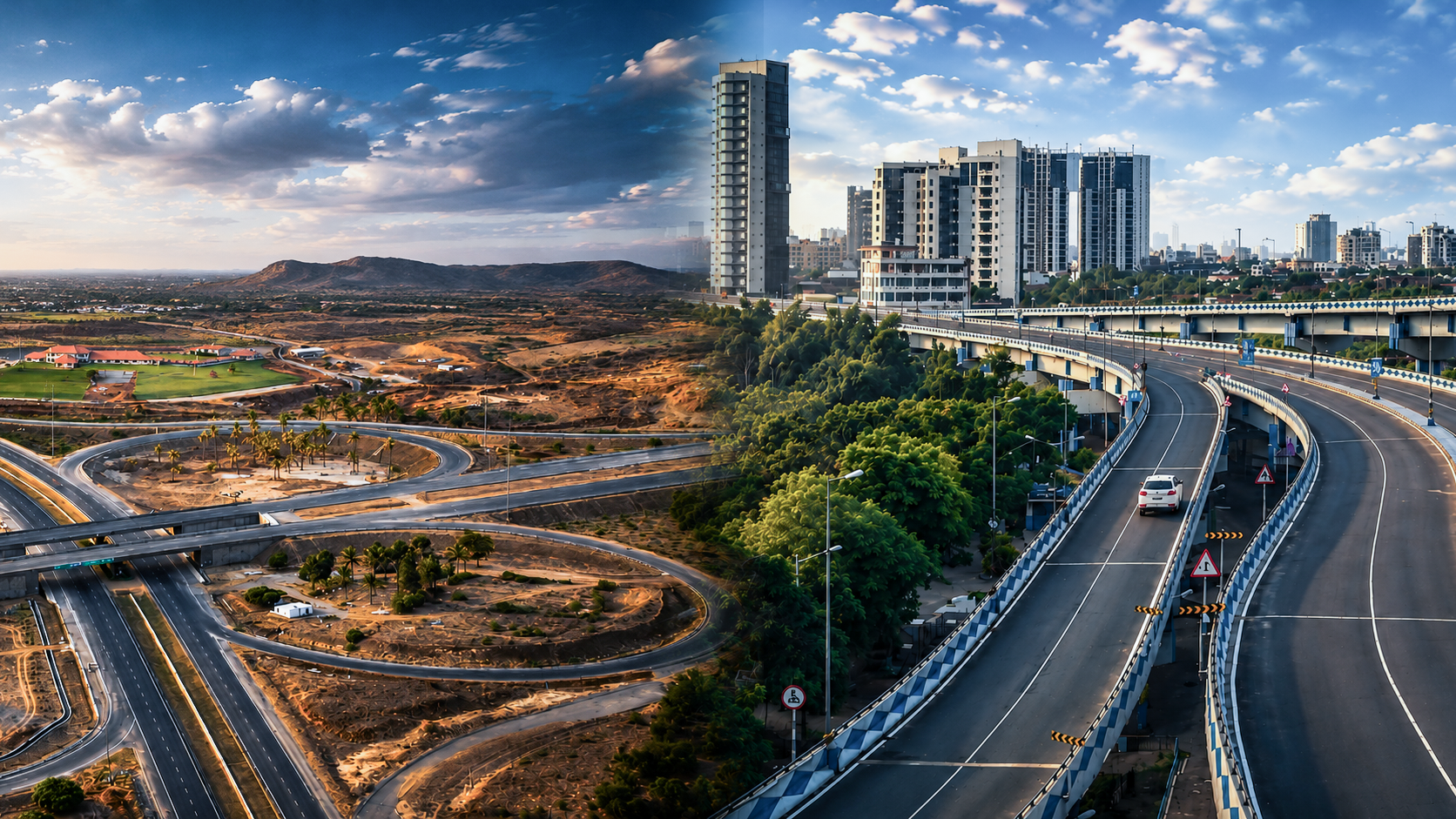
STRR vs PRR Bangalore 2026: Route, Key Differences, Status & Real Estate Impact

Buying & Investing Insights
- August 19, 2026
- 13 min read
Introduction
Bangalore’s rapid expansion has made connectivity one of the biggest factors shaping where people live, work and invest. As the city continues to grow beyond its traditional core, large-scale infrastructure projects are being developed to improve regional connectivity, divert through traffic and support the expansion of new economic centres.
Two important projects in this transformation are the Satellite Town Ring Road (STRR) and the Peripheral Ring Road (PRR), now known as the Bangalore Business Corridor (BBC).
Although both are ring-road projects designed to improve connectivity around Bangalore, they serve different purposes and operate at different scales.
In simple terms, STRR is primarily a regional connectivity corridor connecting Bangalore’s satellite towns and diverting long-distance and freight traffic away from the city, while the PRR/BBC is a shorter urban corridor designed to improve movement between Bangalore’s major arterial roads and reduce congestion around the city’s periphery.
For homebuyers and property investors, understanding this difference is important because infrastructure can influence accessibility, development patterns, employment connectivity and real estate demand.
This guide explains the difference between STRR and PRR, routes, current status in 2026, connectivity benefits, key locations, and potential real estate impact.
Are STRR and PRR the same?
The STRR is part of the national highway network and is designed to separate through traffic from Bangalore’s urban traffic. NHAI documents describe sections of the corridor as part of the Satellite Town Ring Road designed to divert traffic that does not need to enter Bangalore.
The PRR, meanwhile, has been rebranded as the Bangalore Business Corridor. The current project is approximately 73 km long and is being implemented by BDA.
What Is STRR in Bangalore?
The STRR (Satellite Town Ring Road) is a large access-controlled highway corridor planned around Bangalore to improve regional connectivity and divert long-distance, commercial and through traffic away from the city’s congested roads.
The broader STRR network is around 280–288 km, depending on how the larger corridor and connected sections are measured. It links important satellite towns and growth centres around Bangalore and connects with several national and state highways.
The corridor includes locations such as:
- Dobbaspet
- Doddaballapura
- Devanahalli
- Hoskote
- Sarjapur
- Attibele
- Anekal
- Kanakapura
- Ramanagara
- Magadi
- Hosur and surrounding areas
The exact alignment and project sections vary across the wider STRR network, so buyers should distinguish between the overall planned corridor and individual stretches that are currently operational or under construction.
What Is the Main Purpose of STRR?
The primary objective of STRR is to enable traffic travelling between highways, industrial areas and satellite towns to bypass Bangalore instead of passing through the city.
This can help:
- Reduce pressure on Bangalore’s major urban roads
- Improve movement of commercial vehicles
- Connect satellite towns more efficiently
- Support logistics and industrial activity
- Improve access between regional growth centres
- Encourage development along emerging corridors
NHAI describes the STRR as a way to segregate through traffic from Bangalore city traffic, particularly heavy commercial traffic that does not have the city as its destination.
What Is PRR in Bangalore?
The Peripheral Ring Road (PRR) was originally proposed as a major ring road around Bangalore to reduce congestion and improve connectivity between important arterial roads.
The project has since been rebranded as the Bangalore Business Corridor (BBC).
The current project is approximately 73 km long and is planned as an eight-lane, access-controlled corridor with multiple interchanges. The corridor is being developed by the Bangalore Development Authority (BDA).
Why Was PRR Proposed?
Bangalore’s rapid expansion has increased traffic volumes on roads that were originally designed for a smaller city.
The PRR/BBC is intended to:
- Create an alternative route around the city’s outer areas
- Improve movement between major arterial roads
- Reduce pressure on existing urban roads
- Improve access to employment and business corridors
- Support development around Bangalore’s expanding periphery
The project has faced a long history of delays, particularly around land acquisition and compensation.
In 2026, however, the project moved into a more active implementation phase, with BDA inviting tenders for its first package.
Which areas will the Bangalore PRR connect to?
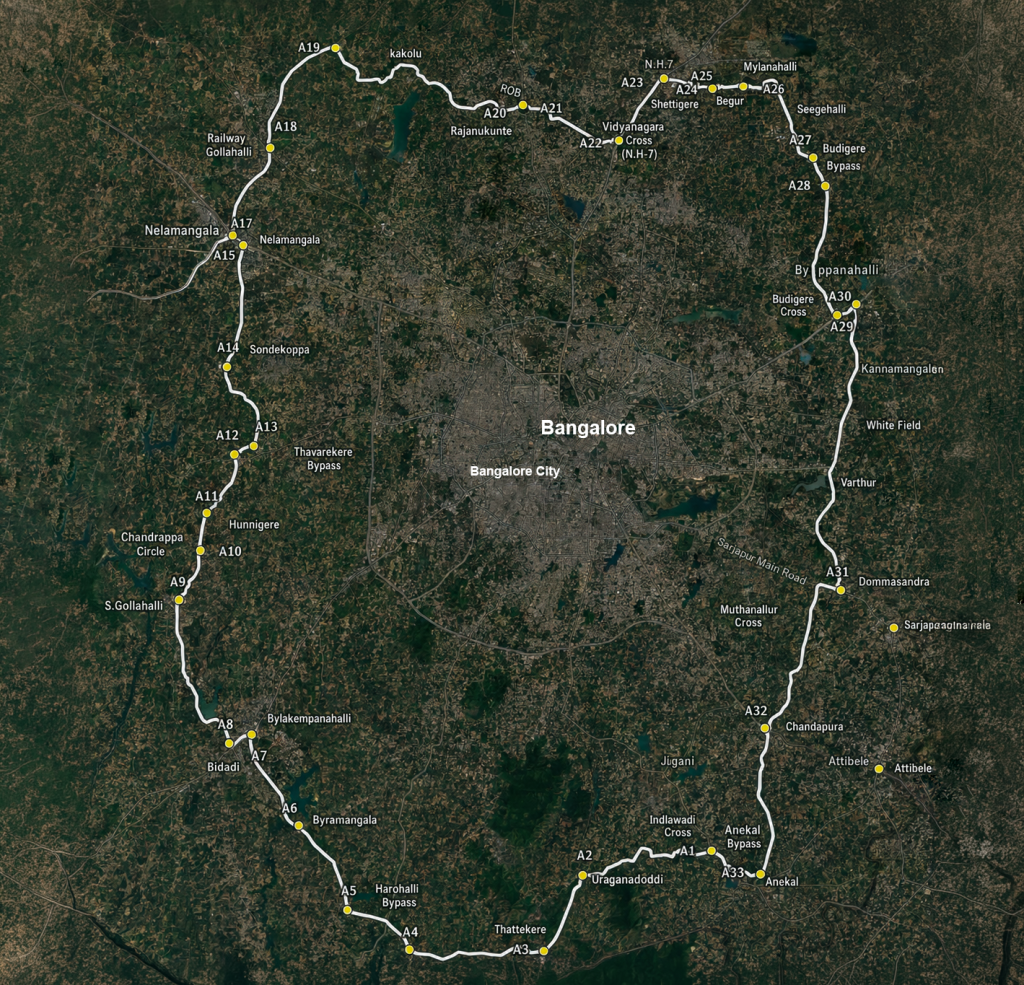
The PRR is planned to encircle Bangalore, basically creating a ring connecting key highways, residential corridors, industrial zones and major employment hubs through seven major stretches:
Stretch 1: Tumkur Road to Hesaraghatta Road (North-West)
This stretch runs along Bengaluru’s northwestern periphery, connecting the NH48 junction near Nelamangala with the Hesaraghatta corridor. The route links emerging residential areas and growth corridors towards Hesaraghatta and Doddaballapur.
Stretch 2: Hesaraghatta Road to Bellary Road (North)
Moving across the northern edge of Bengaluru, this stretch connects Hesaraghatta Road with NH44 near Yelahanka. It provides an important link to the Bellary Road corridor and the Kempegowda International Airport region.
Stretch 3: Bellary Road to Old Madras Road (North-East)
This section connects the airport-side northern corridor with Bengaluru’s eastern belt through NH75. It links growth areas around Thanisandra and Hennur with the wider eastern and northeastern development corridor.
Stretch 4: Old Madras Road to Whitefield/Sarjapur (East)
This stretch connects Old Madras Road with the major IT and residential corridors of Whitefield and Sarjapur. It is particularly significant for improving connectivity across Bengaluru’s rapidly expanding eastern employment belt and providing an alternative to congested sections of the ORR.
Stretch 5: Sarjapur Road to Hosur Road (South-East)
Connecting Sarjapur Road with NH44 and Hosur Road, this stretch provides an alternative route between two of Bengaluru’s major IT and employment corridors. It can improve cross-city connectivity while reducing dependence on congested existing routes.
Stretch 6: Hosur Road to Mysore Road (South-West)
This section connects the southern and southwestern parts of Bengaluru, linking the Hosur Road corridor with Mysore Road through the Kanakapura Road region. It also improves road connectivity towards the city’s developing southwestern periphery.
Stretch 7: Mysore Road to Tumkur Road (West)
Completing the proposed ring, this stretch connects Mysore Road with Tumkur Road along Bengaluru’s western periphery. The corridor provides an additional connection towards Magadi Road and surrounding growth areas, completing the PRR’s wider orbital network around the city.
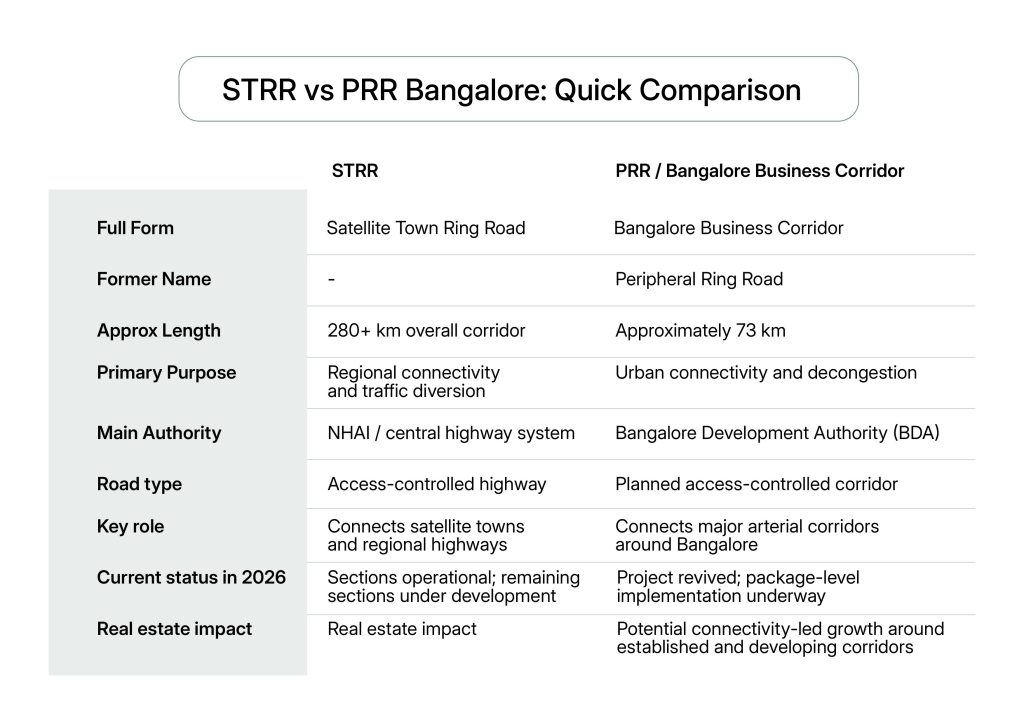
STRR vs PRR: What Is the Main Difference?
The easiest way to understand the difference is to look at what each road is designed to achieve.
1. Purpose
STRR primarily focuses on regional connectivity, highway traffic and the movement of long-distance and commercial vehicles around Bangalore.
PRR/BBC focuses more directly on improving urban and metropolitan connectivity by linking major arterial roads around Bangalore.
2. Scale
STRR is substantially larger, forming a regional ring-road network of more than 280 km.
PRR/BBC is approximately 73 km long.
3. Traffic Served
STRR serves long-distance, freight, commercial and regional traffic.
PRR/BBC is for urban, commuter and commercial traffic moving between Bangalore’s major arterial corridors.
4. Geographic Impact
STRR has a wider regional impact because it connects satellite towns and multiple highway corridors.
PRR/BBC has a more concentrated impact around Bangalore’s urban periphery.
5. Real-Estate Impact
STRR can create opportunities in emerging markets where connectivity, industrial activity and logistics development are still evolving.
PRR/BBC may have a stronger effect on established or developing urban corridors where residential and employment demand already exists.
STRR vs PRR: Route and Connectivity
STRR Route
The broader STRR corridor connects several satellite towns and major highway corridors around Bangalore.
Important locations associated with the wider STRR network include:
- Dobbaspet
- Doddaballapura
- Devanahalli
- Hoskote
- Sarjapur
- Attibele
- Anekal
- Kanakapura
- Ramanagara
- Magadi
- Hosur
The corridor is designed to provide an alternative route for traffic moving between these regional centres without requiring vehicles to enter central Bangalore.
PRR / Bangalore Business Corridor Route
The current Bangalore Business Corridor is approximately 73 km long and connects Tumakuru Road to Hosur Road, passing through Bangalore’s outer growth areas.
The first package currently being progressed covers a section from Tumakuru Road towards Ballari Road, with BDA pursuing a phased implementation due to land acquisition constraints.
The project is planned with multiple interchanges to improve access between the corridor and existing arterial roads.
STRR vs PRR: Current Status in 2026
Infrastructure projects can change quickly, so the status of these roads should always be checked against the latest government and project updates.
What is the STRR Status in 2026?
Parts of the STRR are already operational.
The broader corridor continues to be developed in phases. Union Minister for Road Transport and Highways Nitin Gadkari recently confirmed that the STRR project is nearing completion, with four of its six packages already completed.
The remaining two packages are expected to become operational by September and November 2026. In a written reply to the Rajya Sabha, the Minister also noted that proposals for the six-lane expansion from Oblapura to Kunigal and Kunigal to Hosur have been appraised, paving the way for the next phase of the project.
What is the PRR / Bangalore Business Corridor Status in 2026?
The PRR has moved forward under its new identity as the Bangalore Business Corridor.
In March 2026, BDA invited tenders for the first package of the project. The first package covers approximately 19.8 km from Tumakuru Road towards Ballari Road, with the tender estimated at around ₹3,348 crore and a stated construction period of 36 months.
The wider project has a reported cost of around ₹27,000 crore and has been given a longer-term completion target, with implementation being pursued in phases.
How will the PRR affect land prices around Bangalore?
The impact of improving connectivity is already visible in Sarjapur and its surrounding peripheral markets, where residential and plotted land demand has grown alongside expanding infrastructure and development. Current market trends show plotted land in Sarjapur broadly ranging from ₹3,500–₹7,500 per sq ft, depending on the location, road access and development potential.
STRR vs PRR: Which Areas Could Benefit?
Infrastructure does not affect every location equally.
The biggest potential beneficiaries are generally locations that combine:
1. Proximity to the infrastructure
2. Existing employment demand
3. Good road connectivity
4. Social infrastructure
5. Available land for development
6. Strong residential or commercial demand
Areas Around STRR
The broader STRR network covers several emerging and established growth centres.
Devanahalli
Devanahalli benefits from its proximity to Kempegowda International Airport and its position within North Bangalore’s larger infrastructure ecosystem.
Airport-led development, logistics, commercial activity and large-scale infrastructure are increasingly shaping the area.
Hoskote
Hoskote is strategically positioned towards Bangalore’s eastern side and benefits from its proximity to major highways and industrial corridors.
Its location makes it relevant for logistics, manufacturing, warehousing and residential development.
Doddaballapura
Doddaballapura is another important northern growth corridor connected to the STRR network.
Improved regional connectivity can make such locations more accessible to employment and industrial centres.
Sarjapur and the Southeast Bangalore Corridor
Sarjapur has already developed into a major residential and employment-linked growth corridor.
Its connectivity story is supported not by a single road, but by a combination of existing roads, employment hubs and proposed infrastructure.
How STRR and PRR Could Impact Bangalore Real Estate
Infrastructure and real estate are closely connected because accessibility influences where businesses, workers and residents choose to locate.
However, the impact is rarely immediate or uniform.
STRR’s Potential Real Estate Impact
STRR can support the development of emerging areas by improving regional connectivity.
Potential effects include:
- Increased accessibility to emerging locations
- Greater interest in land and plotted developments
- Expansion of logistics and warehousing
- Industrial development around connected corridors
- New residential communities
- Greater movement between satellite towns
The Bangalore region already has logistics infrastructure linked to the STRR ecosystem. NHAI has also highlighted the Bangalore Multi-Modal Logistics Park as an important logistics initiative intended to improve freight movement and support industrial zones in the region.
For investors, the key opportunity is not simply buying property “near STRR”. It is identifying locations where infrastructure, employment, social infrastructure and actual demand are developing together.
PRR/BBC’s Potential Real-Estate Impact
The Bangalore Business Corridor has a different potential impact.
Because it is designed closer to the city’s existing urban fabric, improved connectivity could benefit locations where residential and employment activity already exists.
Potential effects include:
- Improved commuter connectivity
- Better access between employment corridors
- Greater residential accessibility
- Potential rental-demand benefits
- New commercial development
- Reduced dependence on congested arterial roads
However, because the project is still being implemented in phases, buyers should avoid pricing future benefits into today’s property valuation without considering the project’s actual progress.
STRR vs PRR: Which Is Better for Property Investment?
There is no universal answer.
The better option depends on your investment horizon, risk appetite, purpose and location.
STRR May Suit Long-Term Investors
STRR-connected locations may appeal to investors who are comfortable with emerging markets and have a longer investment horizon.
Potentially suitable for:
- Land banking
- Plotted developments
- Long-term capital appreciation
- Emerging residential markets
- Investors looking at regional growth
The key advantage is the possibility of entering a market before it becomes fully mature.
The trade-off is that development may take time.
Will STRR and PRR Increase Property Prices?
They can influence property demand and prices; infrastructure can improve accessibility and make previously less-connected locations more attractive.
However, property appreciation depends on several factors, including:
- Location
- Employment growth
- Supply and demand
- Social infrastructure
- Connectivity
- Developer reputation
- Project quality
- Regulatory approvals
- Infrastructure completion
- Rental demand
- Overall economic conditions
For this reason, “buying near STRR” or “buying near PRR” should not be treated as an investment strategy by itself.
The strongest opportunities are generally locations where infrastructure improvements are supported by genuine economic and residential demand.
What Is the Future of Bangalore’s Ring-Road Network?
Bangalore’s growth is no longer limited to the traditional city centre.
The broader metropolitan region is developing multiple employment and residential clusters, making regional connectivity increasingly important.
STRR and PRR/BBC address different parts of this challenge.
STRR is designed to strengthen Bangalore’s connection with satellite towns and regional economic centres.
PRR/BBC is designed to strengthen movement around the city’s urban periphery.
Together with highways, metro expansion, airport connectivity and other infrastructure projects, these corridors could influence the next phase of Bangalore’s spatial growth.
But the real impact will depend on how quickly infrastructure is completed and how effectively it connects with existing transport networks and employment centres.
STRR vs PRR: Which One Is Better for Bangalore?
Rather than asking which project is “better”, it is more useful to ask what problem each project is solving.
STRR is primarily about:
- Regional connectivity
- Satellite towns
- Freight movement
- Highway traffic
- Logistics
- Long-term regional growth
PRR/BBC is primarily about:
- Urban connectivity
- Decongestion
- Arterial-road connections
- Commuter movement
- Business corridors
- Bangalore’s peripheral growth
In simple terms:
STRR helps Bangalore connect outward, while PRR/BBC is designed to help Bangalore move around its expanding urban edge.
Conclusion
The STRR vs PRR debate is not really about choosing one road over the other. The two projects have different purposes and influence different parts of Bangalore’s growth story. The Satellite Town Ring Road (STRR) is a large regional connectivity network designed to divert long-distance and freight traffic, connect satellite towns and support growth beyond Bangalore’s core.
The Peripheral Ring Road, now known as the Bangalore Business Corridor (BBC), is a shorter urban corridor designed to improve connectivity between major arterial roads and reduce congestion around the city’s periphery.
Hence, it is important to consider your location, travel needs, connectivity requirements and long-term development potential when evaluating the impact of either project. Together, STRR and BBC can strengthen Bangalore’s wider road network, improve regional connectivity and support the city’s continued expansion.
FAQ’s (Frequently Asked Questions )
1. What is the difference between STRR and PRR in Bangalore?
STRR is a regional ring-road network designed to connect Bangalore’s satellite towns and divert long-distance and freight traffic, while PRR/BBC is a shorter urban corridor designed to improve connectivity around Bangalore and reduce congestion.
2. What is STRR in Bangalore?
The Satellite Town Ring Road (STRR) is a large access-controlled highway network around Bangalore designed to connect satellite towns, improve regional connectivity and divert through traffic away from the city.
3. What is PRR in Bangalore?
The Peripheral Ring Road (PRR) is a long-planned ring road around Bangalore that has been rebranded as the Bangalore Business Corridor (BBC). The current project is approximately 73 km long and is being implemented by BDA.
4. Is PRR the same as Bangalore Business Corridor?
Yes. The long-planned Peripheral Ring Road project has been rebranded as the Bangalore Business Corridor (BBC).
5. Is STRR operational in Bangalore in 2026?
Parts of STRR are operational, while other sections are still under development. A major stretch connecting Hosur and Dobbaspet has been targeted for operation by the end of November 2026.
6. What is the current status of PRR in Bangalore?
The PRR/Bangalore Business Corridor has moved into phased implementation. BDA invited tenders for the first package in 2026, marking progress on the long-delayed project.
7. How long is STRR in Bangalore?
The broader STRR network is generally described as being around 280–288 km, depending on the project scope and sections being referenced.
8. How long is PRR/Bangalore Business Corridor?
The current Bangalore Business Corridor is approximately 73 km long.
9. Which areas benefit from STRR?
The broader STRR network includes or connects growth centres such as Doddaballapura, Devanahalli, Hoskote, Sarjapur, Attibele, Anekal, Kanakapura, Ramanagara and Magadi, along with Dobbaspet and connections towards Hosur.
10. Will STRR increase property prices?
STRR can support property demand and development in connected locations, but property prices also depend on employment, supply and demand, social infrastructure, project quality and overall market conditions.
Read our Latest Blogs

15 Packing and Moving Tips in Bangalore for a Stress-Free House Shift

Lifestyle & Design Inspiration
- September 24, 2026
- 24 min read

Under-Construction Property Buying Checklist: 15 Things to Check Before You Buy in Bangalore
Buying & Investing Insights
- September 18, 2026
- 21 min read
Soulace Villas: Where Space, Privacy and Community Come Together
Featured Property
- September 11, 2026
- 20 min read

Explore Projects

Independent 4 & 5 BHK Villas
starts @ 5 Cr


Sarjapur’s Exclusive 3 BHK Community
starts @ 1.8 Cr

Multi-Gen 2 & 3 BHK Homes
Starts @ 1.87 Cr
Refer & Earn Up to 2%

Invite your friends to explore Modern Spaaces and earn up to 2% of the home value they buy.

Find your Dream Home. Let's talk
Tell us a bit about what you're looking for. One of us will get back to you!