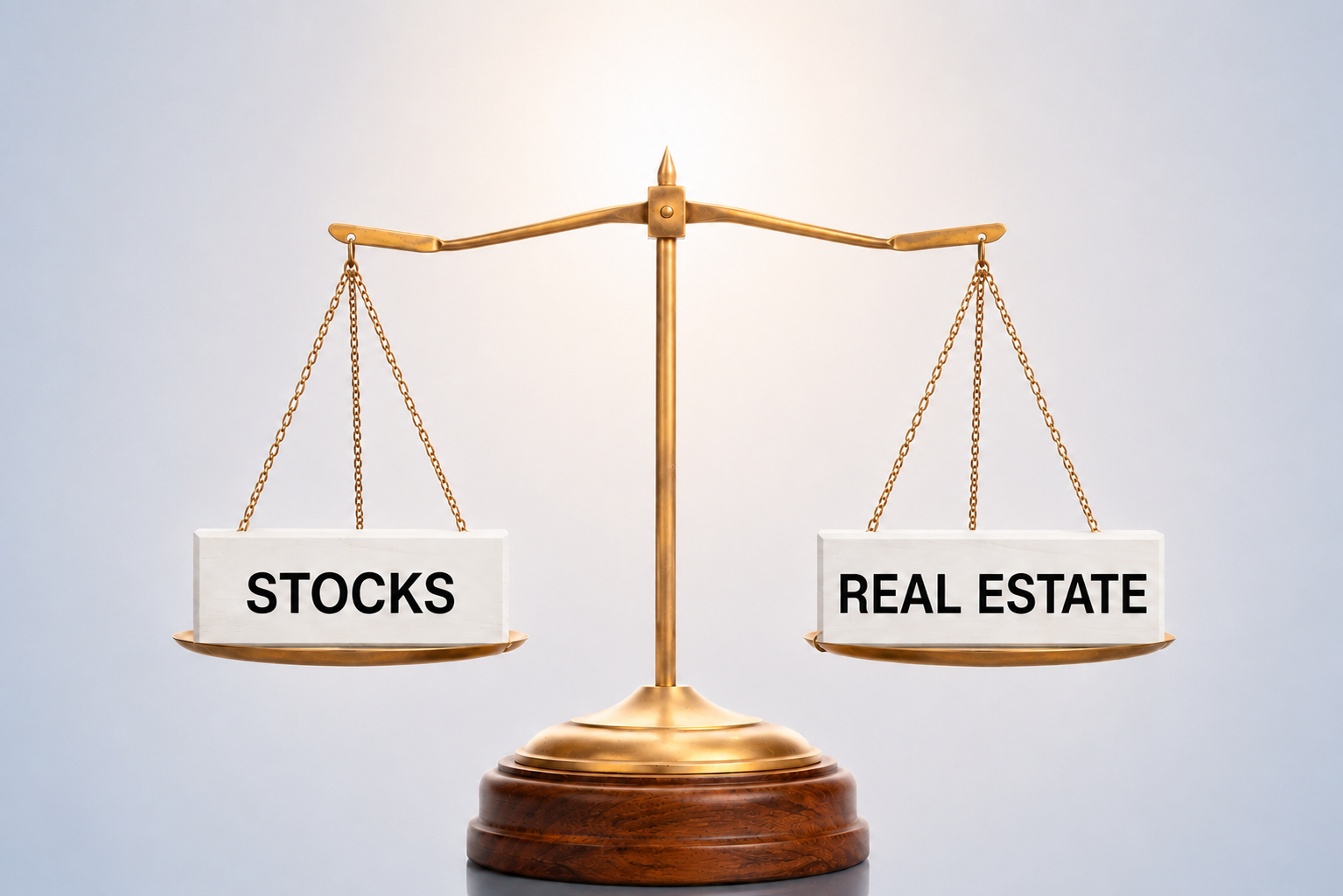
Stocks vs Real Estate: Where Should You Invest in 2026?

Buying & Investing Insights
- May 14, 2026
- 14 min read
Introduction
Stocks or Real Estate? The Most Debated Question in Personal Finance.
We’ve all been there. The market catches a hint of trouble, and before you’ve had your morning coffee, your portfolio is painted in red. Lakhs gone without any warning or explanation. Just a number on a screen that feels unreal.
It’s in those moments that real estate starts to feel less like a conservative choice and more like the smarter one.
But here’s the thing: stocks have made people extraordinarily wealthy, too. The investor who stayed patient through the chaos and didn’t sell saw their portfolio recover and then some. Compounding, liquidity, and the ability to start with as little as a few hundred rupees, stocks have real advantages that are hard to ignore.
So it’s no surprise this debate refuses to die. Both asset classes have built generational wealth. Both carry real risks. And depending on who you ask, you’ll get a completely different answer.
What stocks offer in growth potential and flexibility, real estate matches with stability, tangible ownership, and steady passive income. One moves fast. The other moves quietly, but persistently.
As we move through 2026, the question isn’t really which one is better. It’s which one is right for you, your goals, your risk appetite, and the kind of wealth you’re trying to build.
Why Real Estate Continues to Be a Time-Tested Investment
1. A Proven Hedge Against Inflation
Have you ever watched your savings account balance stay the same while everything around you gets more expensive?
Historically, real estate in India has remained one of the strongest safeguards against inflation. Property values have appreciated steadily over the past two decades, often outperforming inflation and preserving purchasing power over time.
Unlike cash savings that gradually lose value, real estate typically grows alongside rising construction costs, infrastructure development, and urban expansion. In rapidly developing regions, property appreciation can significantly outpace inflation, making it a dependable long-term asset.
Stocks may generate superior returns during strong bull markets, but they remain vulnerable to economic slowdowns, global uncertainty, and investor sentiment. Real estate, on the other hand, tends to move gradually and is less exposed to day-to-day volatility.
2. Tangible, Secure, and Emotionally Reassuring
Have you ever noticed how we instinctively trust what we can see and touch over what we can’t?
It’s a primal survival instinct; our brains are wired to avoid uncertainty because it could mean danger. That’s why, in a world full of volatility and invisible risks, we tend to incline towards things we can see, touch, and trust.
And that’s exactly why real estate feels so secure. Unlike stocks, cryptocurrencies, or other intangible assets, real estate is tangible. You can walk through it, live in it, rent it out; it exists in the real world. That physical presence gives us a deep, almost instinctual sense of stability and control, especially when everything else feels unpredictable.
Whether it’s a residential apartment, villas or a plot, real estate offers an intrinsic value that neither gold nor stocks can replicate. For instance, during the pandemic, while the stock markets saw significant corrections, demand for real estate surged as families sought larger, secure homes, underscoring the asset’s resilience.
3. Generational Wealth and Passive Income
Haven’t we all thought at some point, “If only our grandparents had bought a piece of land back then, life would be so different today”?
That’s the thing about real estate: it isn’t just about owning property, it’s about building something that lasts generations. Pick the right property, and you’re not only watching its value grow year after year, but also creating a steady rental income on the side. The real secret, though, isn’t in buying any property; it’s about spotting areas that are on the rise, especially those backed by government development. That’s where real wealth gets built.
In major Indian metro cities, average residential rental yields hover between 2% to 4%. However, in high-growth micro-markets, particularly infrastructure-backed sectors like Sarjapur Road, returns frequently beat the baseline due to massive tech-corridor demand and connectivity projects like the Satellite Town Ring Road (STRR).
Tax Benefits That Favour Real Estate
Property ownership in India offers broad tax optimisation structures designed to incentivise long-term asset creation.
-
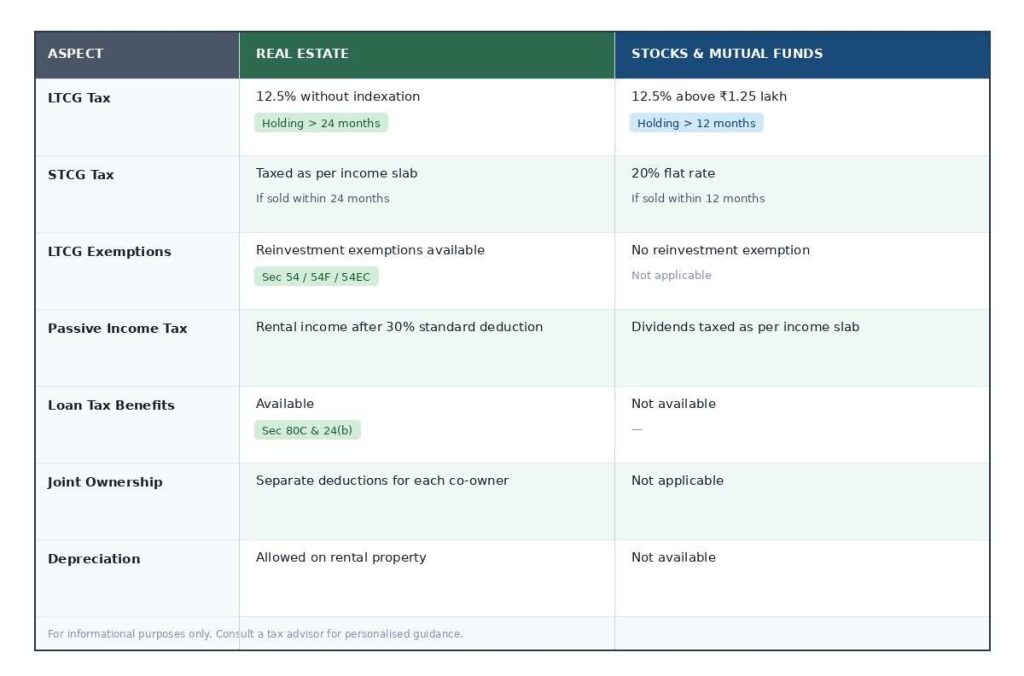
Section 80C: Investors can claim deductions of up to ₹1.5 lakh on home loan principal repayments, stamp duty, and registration charges.
-
Section 24(b): Homeowners can deduct up to ₹2 lakh annually against the interest paid on a home loan for self-occupied properties.
-
Co-Ownership Benefits: Purchasing property jointly allows co-applicants to individually claim these deductions, effectively doubling the household’s tax savings.
-
Section 54 Capital Gains Roll-Over: While the capital gains tax landscape has been standardised across asset classes, real estate investors uniquely retain the ability to defer or completely exempt Long-Term Capital Gains (LTCG) by reinvesting profits into another residential property.
Real Estate vs Stocks: Tax Comparison in India
Stocks Still Remain Attractive
Despite the stability of real estate, stocks remain one of the most powerful wealth-creation tools in the modern economy.
Higher Long-Term Growth Potential
Historically, major stock indices have delivered strong long-term returns through capital appreciation and dividend reinvestment. Investors who remain disciplined through market cycles often benefit significantly from compounding.
Stocks also offer:
- High liquidity
- Easy diversification
- Low entry barriers
- Instant buying and selling
- Exposure to rapidly growing industries
Emerging sectors such as artificial intelligence, healthcare, clean energy, and technology continue to create major opportunities for equity investors.
The Biggest Drawback: Volatility
The primary challenge with stocks is unpredictability.
Equity markets react instantly to:
- Economic downturns
- Interest rate changes
- Geopolitical tensions
- Corporate scandals
- Investor sentiment
Short-term corrections can erase years of gains within weeks. Many retail investors struggle emotionally during volatile phases, leading to panic selling and poor decision-making.
Unlike real estate, stocks also lack physical utility. Their value depends entirely on business performance and market perception.
India’s Real Estate Growth Story in 2026
India’s real estate sector is entering a transformational phase driven by:
- Urbanisation
- Infrastructure expansion
- Government reforms
- Increased transparency
- Institutional investment
The market is projected to approach nearly $1 trillion by 2030, supported by rising housing demand and evolving financing structures.
Institutional confidence in Indian real estate continues to grow through:
- REITs
- Alternative Investment Funds (AIFs)
- Qualified Institutional Placements (QIPs)
- IPO activity
- Greenfield developments
Post-pandemic investment inflows and large-scale land acquisitions indicate strong long-term confidence in the sector’s growth trajectory.
Strategic Verdict: Which Path Is Right for You?
The answer ultimately depends on your investment goals and risk appetite.
Real Estate May Be Better If You Prioritise:
- Capital preservation
- Tangible ownership
- Inflation protection
- Passive rental income
- Long-term family wealth
- Tax efficiency
- Lower volatility
Stocks May Be Better If You Prioritise:
- Higher growth potential
- Liquidity
- Portfolio diversification
- Flexibility
- Long-term compounding
- Smaller investment entry points
Conclusion
For investors seeking stability, predictability, and long-term security, real estate remains one of the safest investments in 2026 and beyond. Its combination of tangible ownership, rental income, tax benefits, and inflation protection makes it particularly attractive during uncertain economic conditions.
Stocks continue to offer unmatched wealth-building potential for disciplined investors willing to tolerate volatility and remain invested through market cycles.
In reality, the strongest long-term strategy is rarely choosing one over the other. A balanced portfolio that combines both real estate and equities allows investors to benefit from the stability of property and the growth potential of the stock market.
The safest investment is not simply the one with the highest returns, but the one that aligns with your financial goals, time horizon, and ability to manage risk effectively.
FAQs (Frequently Asked Questions)
1. Which is safer in the long term, stocks or real estate?
Both can be safe long-term investments depending on your goals. Real estate offers lower volatility, tangible ownership, and inflation protection, making it ideal for capital preservation. Stocks carry higher short-term risk but have historically delivered superior long-term returns through compounding. For most investors, a balanced portfolio that includes both asset classes offers the best risk-adjusted outcome.
2. Is real estate still a strong investment option in India in 2026?
Yes. Driven by structural urbanisation, transparent regulatory frameworks, and extensive infrastructure expansions, India’s real estate sector is on a clear growth trajectory toward a projected $1 trillion market size by 2030. High-growth corridors, such as Sarjapur Road in Bangalore, continue to outpace historical averages in both rental yields and capital appreciation.
3. What are the tax benefits of investing in real estate in India?
Real estate investors in India enjoy several tax advantages. Under Section 80C, you can claim deductions on home loan principal repayment, stamp duty, and registration costs. Section 24(b) allows up to ₹2 lakh deduction on home loan interest annually. Section 54 provides capital gains exemptions on reinvestment. Stocks, by contrast, are subject to direct capital gains and dividend taxes without comparable reinvestment exemptions.
4. What is the average rental yield from real estate in India?
Rental yields in top Indian cities typically range between 2% and 4% annually. However, in high-growth micro-markets with strong infrastructure development, yields can be higher. Beyond rental income, investors in appreciating corridors benefit from capital gains that can significantly boost total returns over a 5–10 year horizon.
5. Why do stocks feel riskier than real estate?
Stocks are priced in real time and react immediately to economic news, interest rate changes, geopolitical events, and investor sentiment. This constant price visibility can make volatility feel acute even when the underlying business is sound. Real estate, on the other hand, is less liquid and prices move slowly, which creates a psychological sense of stability, even though property values can also decline in downturns.
6. Does real estate protect against inflation better than stocks?
Historically, yes. Property values in India have appreciated steadily over the past two decades, often outpacing inflation, particularly in urban and developing regions. Unlike cash savings, real estate tends to grow alongside rising construction costs and infrastructure development. While stocks can also beat inflation over the long term, they are more exposed to short-term economic shocks.
Read our Latest Blogs

What is Property Mutation? Meaning, Importance & Process in Karnataka (2026)

Real Estate Basics
- June 16, 2026
- 12 min read

Property Registration in Bangalore: Process, Documents, Charges & Complete Guide (2026)
Regulatory & Legal Guide
- June 5, 2026
- 13 min read

4 & 5 BHK Luxury Villas in Sarjapur Road: Experiential Living at Soulace
Featured Property
- May 20, 2026
- 15 min read

Explore Projects


Independent 4 & 5 BHK Villas
starts @ 4.5 Cr



Sarjapur’s Exclusive 3 BHK Community
starts @ 1.8 Cr


Multi-Gen 2 & 3 BHK Homes
Starts @ 1.87 Cr
Refer & Earn Up to 2%

Invite your friends to explore Modern Spaaces and earn up to 2% of the home value they buy.

Find your Dream Home. Let's talk
Tell us a bit about what you're looking for. One of us will get back to you!