Bangalore Metro Impact on Property Prices: What Buyers Should Know

Buying & Investing Insights
- October 5, 2026
- 10 min read
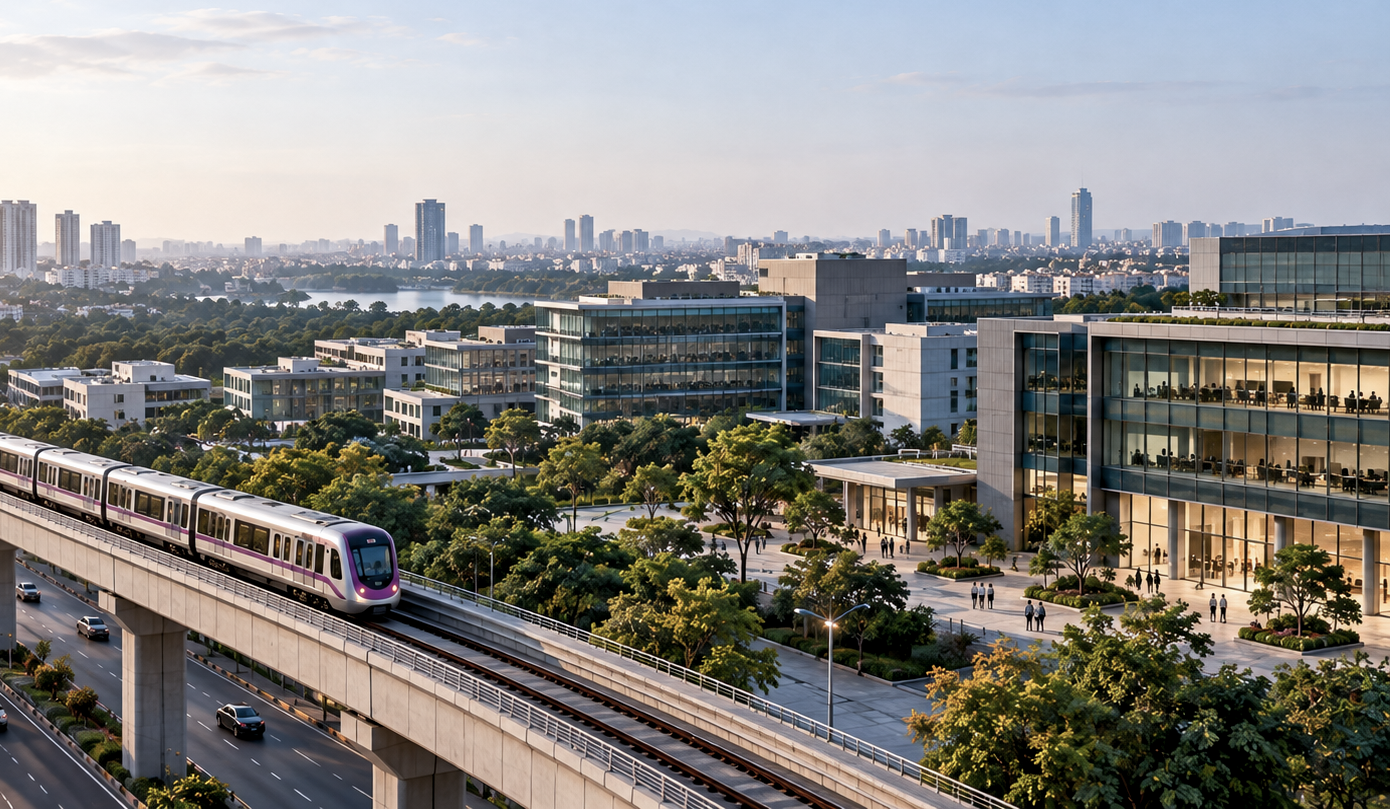
The Bangalore Metro’s impact on property prices has become an important consideration for homebuyers and real estate investors across Bangalore.
As the Namma Metro network expands, locations that were once considered difficult to access are becoming better connected to employment hubs, commercial districts and established residential neighbourhoods. Improved connectivity can influence where people choose to live, how they commute and how much demand a particular location receives.
For buyers considering apartments in Sarjapur Road, metro connectivity is particularly relevant. Sarjapur Road is already an established residential and employment corridor with access to major IT hubs, schools, healthcare, retail and road networks. The proposed Sarjapur–Hebbal Metro corridor could add another layer of connectivity to this existing infrastructure ecosystem.
What is the current situation with the Bangalore Metro?
Bangalore’s Namma Metro is currently in a major expansion phase, with the existing Purple, Green and Yellow lines operational and several new corridors progressing towards completion. The Pink Line is nearing passenger operations, while the Blue Line connecting the Outer Ring Road corridor to Kempegowda International Airport is being developed in phases. Further expansion under Phase 3 is also planned, although some proposed corridors, including the Sarjapur–Hebbal line, are in the planning phase. Overall, the Metro network is gradually extending beyond the city’s established areas, improving connectivity between residential neighbourhoods, employment hubs and the airport.
Does Bangalore Metro Increase Property Prices?
Yes, metro connectivity can influence property prices and rental demand by improving accessibility and making a location more attractive to homebuyers and tenants. However, the impact varies from one location to another.
Properties close to operational metro stations may benefit from improved convenience and a wider pool of potential buyers and tenants. Proposed metro corridors can also influence buyer expectations before a line becomes operational, although future benefits carry execution and timeline risks.
Metro connectivity should not, however, be treated as an automatic guarantee of property appreciation. The actual impact depends on factors such as:
- Distance from the metro station
- Employment growth
- Road connectivity
- Social infrastructure
- Project quality
- Housing demand
- Overall development of the micro-market
In other words, metro connectivity is one factor influencing property prices, not the only one.
How Has Bangalore Metro Changed the Real Estate Market?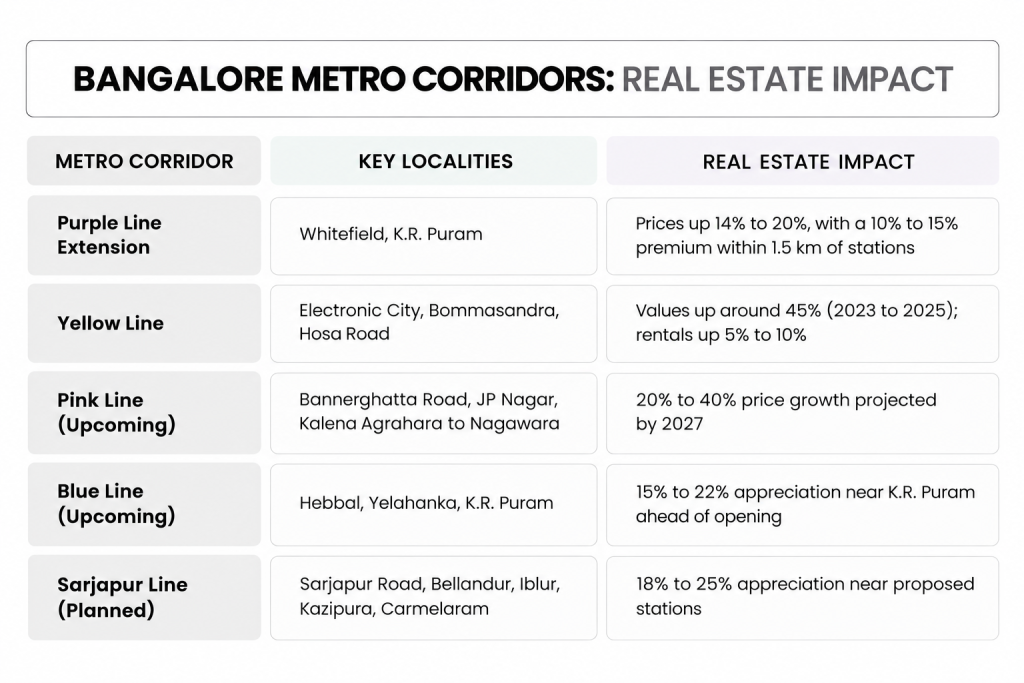
Bangalore’s metro network has expanded considerably, connecting established residential areas with major employment and commercial corridors.
The first phase of Namma Metro began operations in 2011, with the network expanding through subsequent phases. The Purple and Green Lines created important north-south and east-west connections, while newer corridors have extended metro access towards major employment centres.
The Yellow Line, connecting RV Road and Bommasandra, began passenger operations in August 2025, strengthening connectivity across Bangalore’s southern and southeastern employment corridor.
For real estate, the significance of these developments goes beyond the metro station itself.
Better public transport can:
- Improve access to employment hubs
- Reduce dependence on private vehicles
- Make daily commuting more convenient
- Increase the appeal of surrounding residential areas
- Support rental demand
- Expand the pool of potential homebuyers
- Encourage commercial development around transit corridors
This makes metro connectivity an important part of the broader Bangalore real estate growth story.
How Does Metro Connectivity Affect Property Prices in Bangalore?
Metro connectivity can influence real estate through several interconnected factors.
1. Improved Connectivity
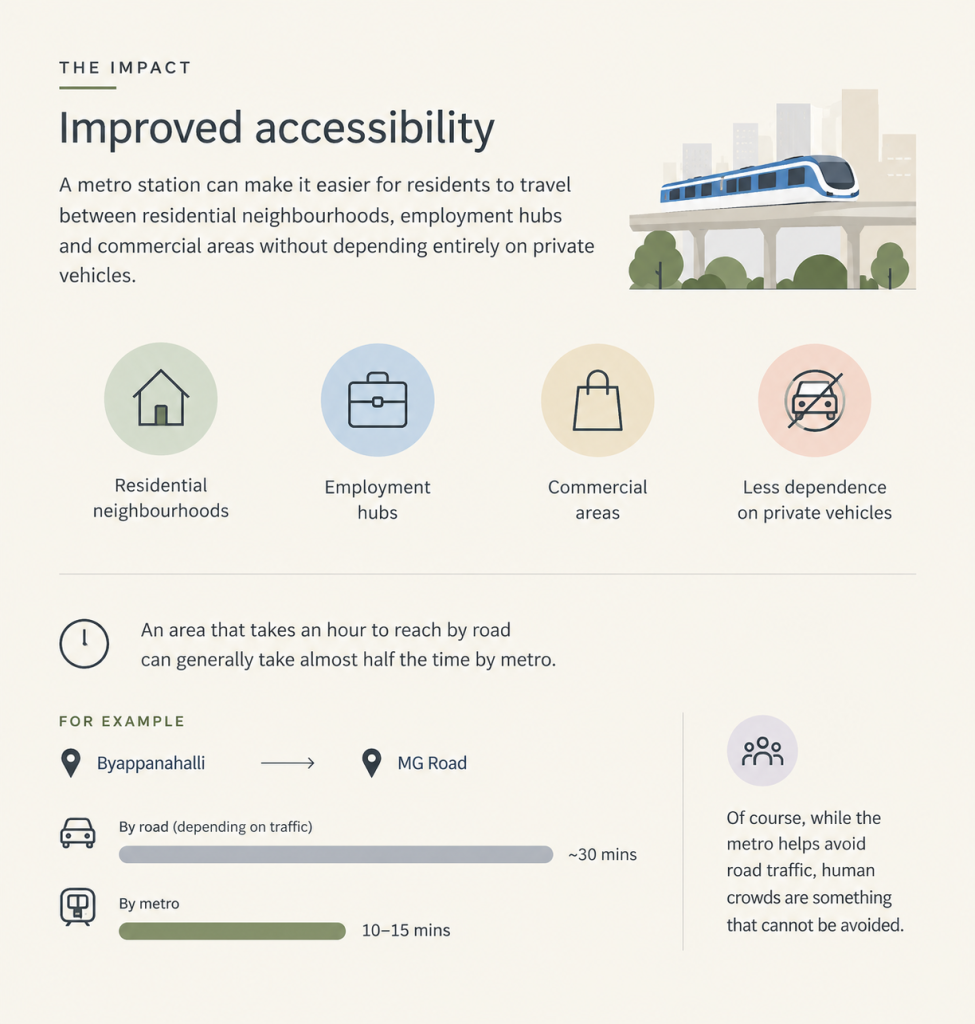
The most direct impact is improved accessibility. A metro station can make it easier for residents to travel between residential neighbourhoods, employment hubs and commercial areas without depending entirely on private vehicles.
An area that takes an hour to reach by road can generally take almost half the time by metro.
For example, travelling from Byappanahalli to MG Road, which could earlier take around 30 minutes by road depending on traffic, can now take just 10–15 minutes by metro. Of course, while the metro helps avoid road traffic, human crowds are something that cannot be avoided.
For Bangalore, where traffic congestion is an important consideration for homebuyers, reliable public transport can influence how people evaluate a location.
2. Reduced Dependence on Private Vehicles
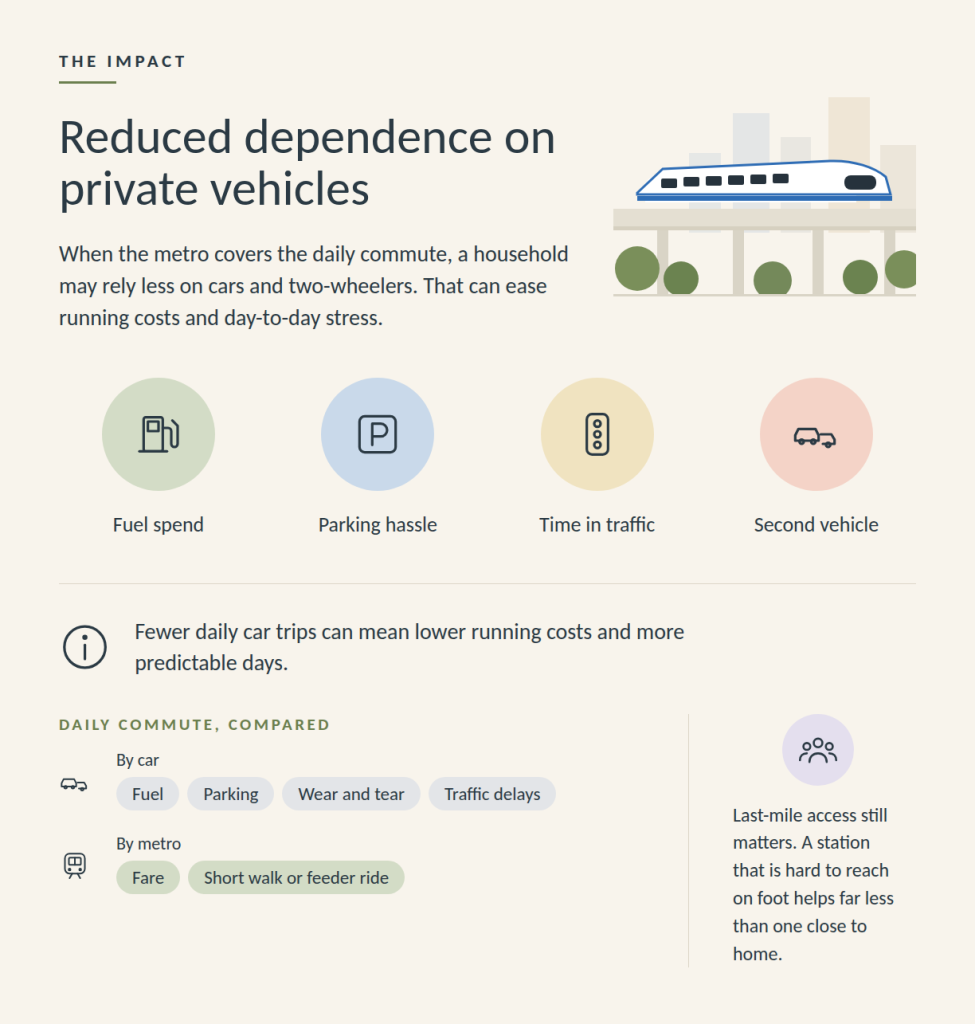
A well-connected metro corridor provides residents with an alternative to driving.
For professionals travelling regularly to IT parks and business districts, this can influence where they choose to rent or buy a home.
Better public transport can also expand the geographical area that buyers and tenants consider when searching for housing. Also those who
3. Increased Rental Demand
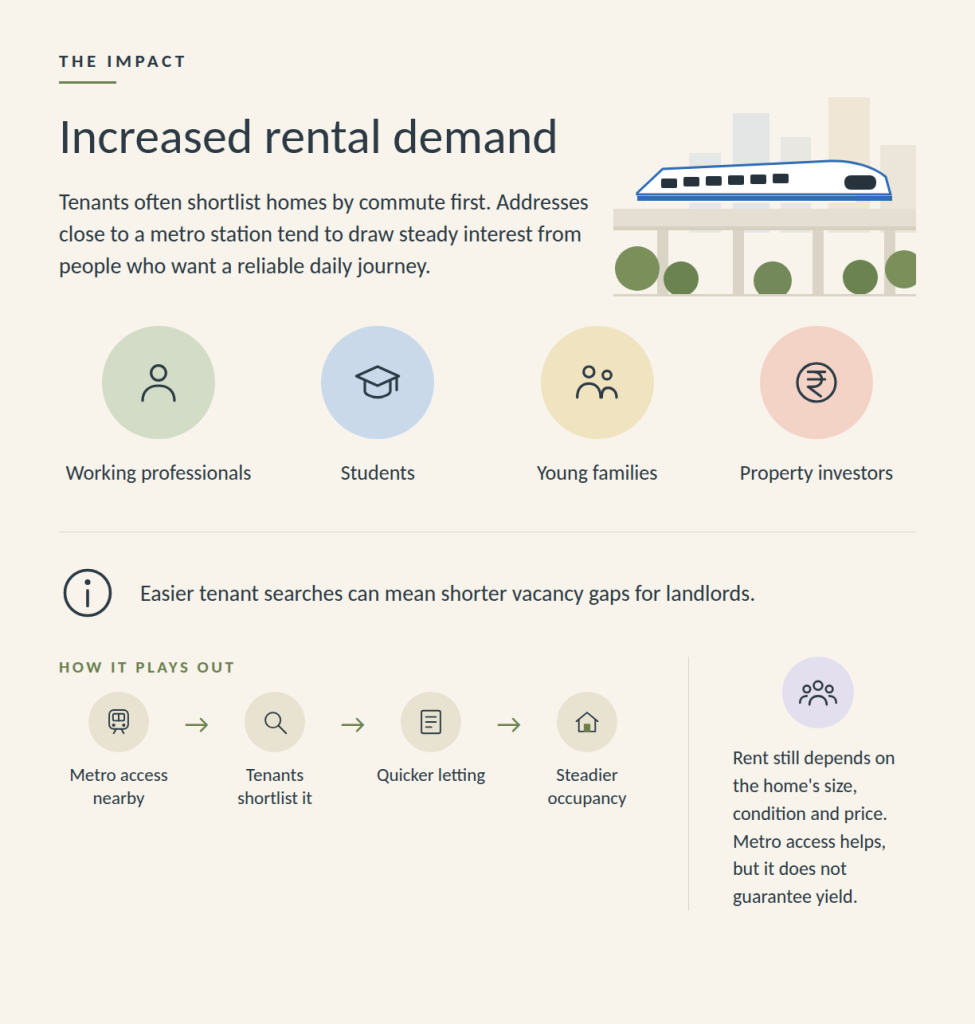
Rental markets can respond to improved connectivity because tenants often prioritise convenient access to workplaces and public transport. For landlords, a location with access to employment hubs, roads and metro connectivity can potentially attract a broader tenant pool.
However, rental returns should always be calculated using actual purchase prices, prevailing rents, maintenance costs, taxes and vacancy assumptions.
4. Improved Resale Appeal

Connectivity can also influence resale demand. A home located within convenient reach of public transport can appeal to multiple buyer profiles, including professionals, families and investors.
However, metro proximity is only one part of resale value. A property’s age, builder reputation, construction quality, floor plan, amenities, pricing and neighbourhood infrastructure continue to matter.
5. Location Premium
Homes within convenient reach of a metro station can sometimes command a premium compared with otherwise similar properties located farther away.
However, “near metro” needs careful examination.
Before considering a property metro-connected, buyers should check:
- Actual walking distance
- Road connectivity
- Last-mile transport
- Pedestrian access
- Station accessibility
- Traffic conditions
- Nearby employment hubs
- Social infrastructure
- Project quality
Does Metro Connectivity Increase Property Prices in Whitefield?
One of the clearest Bangalore examples is Whitefield and the extension of the Purple Line.
Whitefield was already a major IT and employment destination before metro connectivity arrived. The operational extension of the Purple Line created a direct public transport connection between Whitefield and other important parts of Bangalore.
Real estate market reports subsequently recorded stronger demand and price movement in metro-connected eastern Bangalore markets.
According to reports, property prices in Whitefield had increased by around 8-20% following the Purple Line extension, while monthly rentals in the area had increased by around 7–10%.
More recent reporting also found continued demand momentum in metro-linked Bangalore markets. The report includes that Whitefield recorded a 14% rise in homebuyer demand, while K.R. Puram recorded an 18% increase. The same report noted rental growth of more than 10% in several metro-linked IT corridors, including Whitefield, K.R. Puram and Electronic City.
What Does the Whitefield Example Tell Homebuyers?
The important takeaway is not that every property near a metro station will appreciate by a specific percentage.
Instead, Whitefield demonstrates how three factors can work together:
Employment + Infrastructure + Connectivity
Whitefield already had strong employment demand because of its IT ecosystem. Metro connectivity then improved accessibility to the area. Together, these factors supported stronger residential and rental demand.
This distinction is important for buyers:
” Metro infrastructure tends to have a stronger impact when it connects an area that is already seeing growth in housing, employment and social infrastructure. Sarjapur is a good example, with established IT hubs, some of Bangalore’s leading schools and improving regional connectivity through corridors such as the STRR and PRR. Together, these factors are shaping Sarjapur in ways that increasingly resemble the growth story of Whitefield.”
Why Is Metro Connectivity Important for Sarjapur Road Real Estate?
Sarjapur Road has evolved from a peripheral residential corridor into one of Bangalore’s important residential and employment locations.
Its appeal comes from more than one infrastructure project. The corridor benefits from proximity to:
- Outer Ring Road
- Bellandur
- Electronic City
- Whitefield
- Marathahalli
- Major IT and employment hubs
- Schools
- Hospitals
- Retail and entertainment destinations
- Existing road networks
This combination has supported demand for 2, 2.5 and 3 BHK apartments on Sarjapur Road.
The proposed metro connectivity adds another potential layer to this existing infrastructure ecosystem.
Is There a Metro on Sarjapur Road?
No, there is currently no operational metro line directly on Sarjapur Road.
The proposed Sarjapur–Hebbal Metro corridor, commonly referred to as the Phase 3A Red Line, is approximately 37 km long with around 28 stations. The project was approved by the Karnataka Cabinet in December 2024 and remains subject to detailed planning and clearances.
As of 2026, buyers should therefore treat the Sarjapur Metro as a future infrastructure opportunity rather than an existing commuting option.
For current metro access, residents in different parts of the Sarjapur Road corridor may need to use existing operational stations depending on their exact location.
The distinction between operational, under-construction and proposed infrastructure is important when evaluating property.
How Could the Sarjapur Metro Affect Property Prices?
The potential impact of metro connectivity on Sarjapur Road is best understood through the area’s existing fundamentals.
Employment
Sarjapur Road is connected to several major employment clusters across Southeast Bangalore.
Residential Demand
The corridor already has a large residential ecosystem catering to professionals and families.
Social Infrastructure
Schools, hospitals, retail destinations and everyday services contribute to its residential appeal.
Road Connectivity
Existing road infrastructure connects the area with major employment corridors, although traffic remains an important consideration.
Future Public Transport
The proposed metro could provide another mode of connectivity across Bangalore.
Together, these factors make the metro relevant as part of the long-term Sarjapur Road real estate story.
Metro Connectivity vs Existing Infrastructure: What Should Property Buyers Consider?
A common mistake is to evaluate a property entirely around a future metro line.
Instead, buyers should ask:
“Would I still consider this location if the metro takes longer than expected?”
If the answer is yes because the property already offers good access to employment, schools, healthcare, roads and everyday amenities, the future metro can be considered an additional potential benefit.
This creates a more balanced way of evaluating property investment in Bangalore.
How Can Metro Connectivity Influence Rental Demand?
Rental demand is closely linked to accessibility.
For Bangalore’s large working population, proximity to employment hubs can be a major factor when selecting a rental home.
A property with access to:
Metro + Roads + Employment + Schools + Retail + Healthcare
can appeal to a broader range of tenants.
This is particularly relevant in technology-driven corridors such as Southeast Bangalore.
However, investors should not assume that metro proximity automatically means high rental yield.
Rental yield depends on:
- Purchase price
- Monthly rent
- Maintenance
- Property taxes
- Vacancy
- Financing costs
- Property management expenses
The metro can improve rental appeal, but the investment calculation still needs to work independently.
Is Metro Connectivity the Only Factor That Matters for Property Prices?
No. The real estate impact of a metro line depends on the surrounding ecosystem.
For example, a station surrounded by employment hubs and established residential development can have a different impact from a station in an area with limited housing demand.
Infrastructure-led real estate growth usually involves multiple factors working together:
Employment + Housing Demand + Roads + Metro + Social Infrastructure + Commercial Development
This is why buyers should evaluate the entire micro-market rather than simply looking at the distance to the nearest metro station.
Modern Spaaces: Building Homes in Bangalore’s Growth Corridors
At Modern Spaaces, the focus is not simply on building homes near a particular infrastructure project.
The broader approach is to develop residential communities in locations where connectivity, everyday convenience, infrastructure and long-term urban growth come together.
Modern Spaaces offers apartments, villas and plotted developments across Bangalore, with projects designed around the evolving needs of homebuyers.
For buyers evaluating a Modern Spaaces home, infrastructure is one part of the location story.
The larger consideration is how the home fits into the existing and emerging ecosystem around it:
Work + Connectivity + Education + Healthcare + Community + Lifestyle
This is particularly relevant when evaluating locations such as Sarjapur Road, where current road connectivity and social infrastructure are already important, while future public transport improvements could add another layer of accessibility.
Should You Buy Property Before Metro Completion?
There is no universal answer to whether buying before or after metro completion is better.
The decision depends on:
- Property price
- Existing connectivity
- Project quality
- Developer track record
- Location fundamentals
- Construction stage
- Rental demand
- Intended holding period
- Personal use requirements
Buying before completion can provide exposure to potential future infrastructure benefits, but it also means accepting uncertainty around project timelines and execution.
Buying after completion may provide greater clarity about actual connectivity, travel times and neighbourhood development.
The key is to avoid treating a proposed metro line as a guaranteed appreciation event.
What Should You Check Before Buying Property Near a Metro Corridor?
1. Verify the Metro Status
Check whether the line is:
- Proposed
- Approved
- Under construction
- Operational
2. Check the Actual Station Distance
Look beyond the advertised “near metro” claim.
Check the actual road, walking and driving distance.
3. Study Existing Connectivity
Evaluate how easily you can reach your workplace, schools, hospitals and other regular destinations today.
4. Check the Surrounding Infrastructure
Look at:
- Roads
- Water supply
- Drainage
- Schools
- Hospitals
- Retail
- Public transport
- Employment hubs
5. Evaluate the Property
Consider:
- RERA registration
- Developer track record
- Construction quality
- Carpet area
- Floor plans
- Amenities
- Maintenance
- Delivery timeline
6. Calculate the Investment
For investment properties, compare:
Purchase Price + Financing + Maintenance + Taxes + Vacancy
against:
Expected Rental Income + Potential Resale Demand
This provides a more realistic picture than looking at metro proximity alone.
Bangalore Metro and Real Estate: The Bigger Picture
The impact of Namma Metro on Bangalore property prices is not simply about stations and property values.
It is about how infrastructure changes the relationship between where people live and where they work.
When a new metro corridor improves access to an employment hub, residents may be willing to consider a wider range of neighbourhoods.
When more people consider an area, housing demand can increase.
When housing demand increases alongside employment and social infrastructure, developers may respond with more residential and commercial development.
The Whitefield experience provides a useful Bangalore example of how improved metro connectivity can become part of a wider real estate growth story.
For Sarjapur Road, the same principle can be considered, but the outcome will depend on the eventual metro alignment, station locations, execution timeline and continued development of the surrounding corridor.
Key Takeaways for Homebuyers
If you are considering buying property in Bangalore, keep these five points in mind:
1. Metro connectivity can add value to a location
Better accessibility can improve residential and rental appeal.
2. Existing infrastructure matters
Do not buy purely because of a future metro announcement.
3. Employment drives housing demand
Metro infrastructure is particularly relevant when it connects residential areas with strong employment centres.
4. Station distance matters
“Near metro” is not a useful metric without checking actual accessibility.
5. Look at the complete location story
The strongest residential locations combine:
Connectivity + Employment + Social Infrastructure + Housing Demand + Quality Development
Conclusion: What Does Bangalore Metro Mean for Property Buyers?
The Bangalore Metro impact on property prices is best understood as part of a broader urban-development story.
Metro connectivity can improve accessibility, influence rental demand and strengthen the appeal of well-connected neighbourhoods. Real-world examples such as Whitefield show how metro connectivity can become an important component of an established employment and residential ecosystem.
For Sarjapur Road, the proposed metro adds another potential layer to an already established residential corridor.
But the most important consideration for a homebuyer is not simply whether a metro line is planned. It is whether the property offers a strong combination of current connectivity, employment access, social infrastructure, liveability and long-term development potential.
For Modern Spaaces, this broader approach to location is central to building homes that respond to how Bangalore is growing and how people want to live.
Frequently Asked Questions About Bangalore Metro and Property Prices
1. How does Bangalore Metro impact property prices?
The Bangalore Metro can influence property prices by improving accessibility and increasing the appeal of well-connected neighbourhoods. The actual impact varies by location and depends on employment growth, existing infrastructure, station proximity, housing demand and broader market conditions.
2. Do metro stations increase property prices in Bangalore?
Metro connectivity can contribute to higher property demand and, in some locations, higher property values. However, no fixed percentage of appreciation applies to every metro-connected property.
3. Is there a metro on Sarjapur Road?
There is currently no operational metro line directly on Sarjapur Road. The proposed Sarjapur–Hebbal corridor is planned to improve future connectivity, but buyers should verify the latest official project status and timeline before making a purchase decision.
4. Will the Sarjapur Metro increase property prices?
Improved metro connectivity could increase the appeal of Sarjapur Road by improving access to other parts of Bangalore. However, any impact on property prices will depend on the final alignment, station locations, execution and the area’s broader residential and employment growth.
5. Is it better to buy property before the metro starts?
There is no universal answer. Buying before metro completion may provide exposure to future infrastructure improvements, but it also involves uncertainty around timelines and execution. Buyers should first assess the property’s current connectivity, price and overall location fundamentals.
6. Which areas in Bangalore have benefited from metro connectivity?
Metro-linked areas such as Whitefield and K.R. Puram have seen increased residential demand alongside improved connectivity and strong employment ecosystems. Recent market reporting has also recorded demand and rental growth in other metro-connected Bangalore locations.
7. Does metro connectivity increase rental demand?
It can. Convenient access to public transport can make a property more attractive to tenants, particularly professionals who commute to employment hubs. However, rental demand also depends on rent levels, housing quality, employment concentration and neighbourhood infrastructure.
8. How far should a property be from a metro station?
There is no universal ideal distance. Buyers should consider actual walking distance, road access, last-mile connectivity, pedestrian infrastructure and the quality of the surrounding neighbourhood rather than relying on a simple kilometre figure.
9. Is buying property near a proposed metro line a safe investment?
A proposed metro line should be treated as one factor in the investment decision, not as a guarantee of appreciation. Buyers should verify the project’s current status and evaluate the property’s existing connectivity, developer, pricing, rental demand, infrastructure and long-term liveability.
10. Does metro connectivity influence homebuyer demand?
Yes. Convenient public transport can influence where buyers and tenants choose to live because it can improve access to employment hubs and reduce dependence on private vehicles. The effect is generally stronger when metro connectivity is supported by good roads, employment opportunities and established social infrastructure.
11. Why is metro connectivity important for Bangalore real estate?
Bangalore has a large technology and corporate workforce, making commute time an important consideration for many residents. Metro connectivity can improve access between residential and employment areas, which can influence housing demand and the attractiveness of different real estate corridors.
12. What should I check before buying an apartment near a metro corridor?
Check the metro’s actual status, station distance, existing road connectivity, employment hubs, schools, hospitals, water and civic infrastructure, developer track record, RERA registration, project quality, pricing, maintenance costs and potential rental demand.
Read our Latest Blogs

15 Packing and Moving Tips in Bangalore for a Stress-Free House Shift

Lifestyle & Design Inspiration
- September 24, 2026
- 24 min read
Under-Construction Property Buying Checklist: 15 Things to Check Before You Buy in Bangalore
Buying & Investing Insights
- September 18, 2026
- 21 min read

Soulace Villas: Where Space, Privacy and Community Come Together
Featured Property
- September 11, 2026
- 20 min read
Explore Projects


Independent 4 & 5 BHK Villas
starts @ 5 Cr


Sarjapur’s Exclusive 3 BHK Community
starts @ 1.8 Cr

Multi-Gen 2 & 3 BHK Homes
Starts @ 1.87 Cr

Refer & Earn Up to 2%

Invite your friends to explore Modern Spaaces and earn up to 2% of the home value they buy.

Find your Dream Home. Let's talk
Tell us a bit about what you're looking for. One of us will get back to you!