
What is Property Mutation? Meaning, Importance & Process in Karnataka (2026)

Real Estate Basics
- June 16, 2026
- 14 min read
Introduction
Buying a property is one of the biggest financial decisions you’ll ever make. However, owning a property doesn’t end with registration. To ensure your ownership is officially recognised in government records, you must complete a crucial legal process known as property mutation or Khata transfer.
Whether you’ve purchased a home, inherited land, received property as a gift, or acquired ownership through a will, mutation ensures that government revenue records reflect the rightful owner. It also helps transfer property tax responsibilities and prevents future ownership disputes.
In this blog, we’ll explain what property mutation is, its importance, the process in Karnataka, the required documents, and how to apply online in 2026.
What is Property Mutation?
Property mutation is the process of updating ownership details in government land and revenue records after a property changes hands.
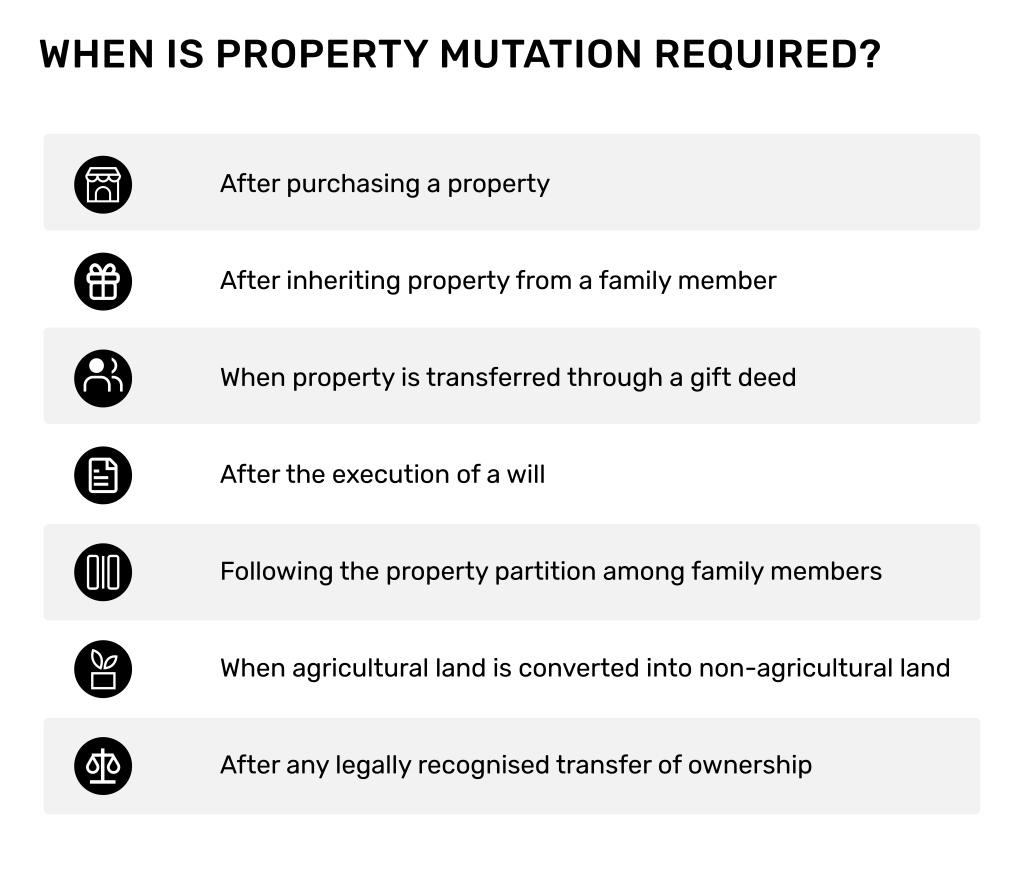
When a property is sold, inherited, gifted, or transferred through a will, the new owner must apply for mutation so that the local revenue authorities can update their records. Once approved, the new owner’s name replaces the previous owner’s name in official land records.
While property registration establishes legal ownership, mutation ensures that government records and property tax obligations are updated accordingly.
Key Highlights of Property Mutation
1. Ownership Records Are Updated
Mutation officially records the new owner’s name in government revenue records.
2. Legal Recognition
It provides administrative recognition of the ownership transfer and reduces the risk of future disputes.
3. Property Tax Transfer
Property tax liabilities are shifted to the new owner after mutation is completed.
4. Verification by Authorities
Revenue authorities verify documents and ownership details before approving the mutation request.
5. Mutation Certificate Issued
Once approved, a mutation certificate or an updated record is generated as proof of the record update.
6. Nominal Processing Fees
Most states charge a small fee for processing mutation applications.
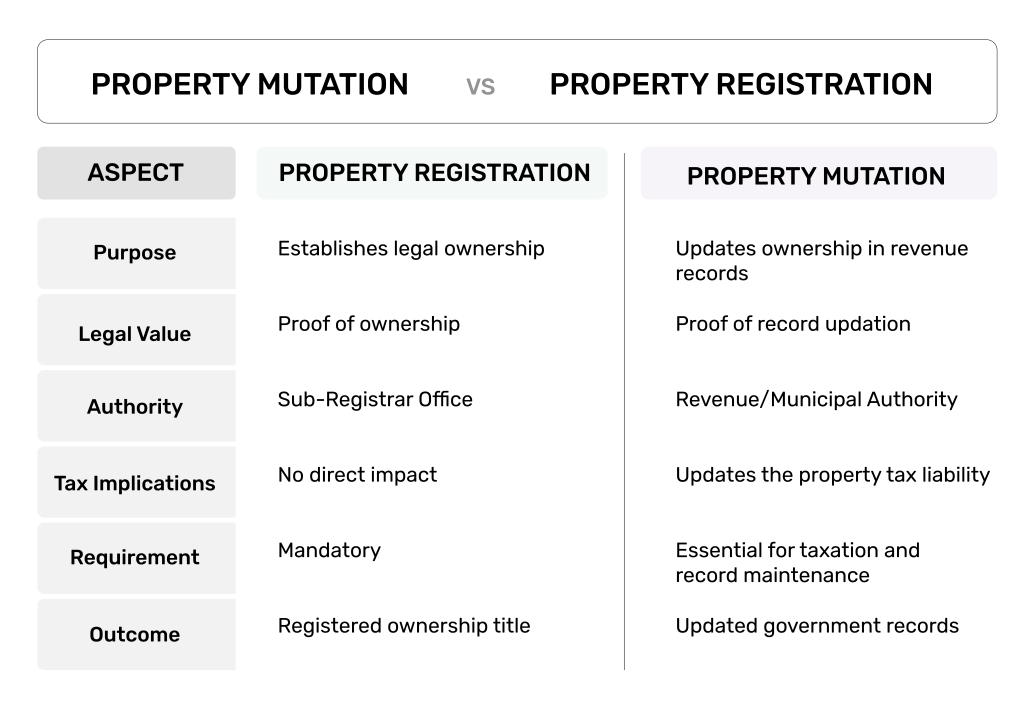
Both registration and mutation are important. Registration confirms ownership, while mutation ensures that government records accurately reflect that ownership.
Why is Property Mutation Important?
1. Legal Recognition of Ownership
Mutation helps establish your name in official land and revenue records.
2. Hassle-Free Property Tax Payments
Property taxes can only be properly assessed and collected when ownership records are updated.
3. Smooth Property Resale
Prospective buyers often verify mutation records before purchasing a property.
4. Protection Against Disputes
Updated records can serve as supporting evidence in ownership-related disputes.
5. Easier Loan Approvals
Banks and financial institutions often require up-to-date mutation records before approving loans secured by property.
6. Better Property Management
Accurate records ensure smooth handling of future transfers, inheritances, and transactions.
Documents Required for Property Mutation
To apply for property mutation, you will need:
- Registered Sale Deed or Title Deed
- Latest Property Tax Receipts
- Aadhaar Card or other ID proof
- Address Proof
- Encumbrance Certificate (if applicable)
- Death Certificate (for inheritance cases)
- Legal Heir Certificate or Succession Certificate
- Gift Deed or Will (where applicable)
- Affidavit as prescribed by local authorities
Requirements may vary depending on the nature of the ownership transfer and local regulations.
Key Details Included in a Karnataka Mutation Record
A mutation record in Karnataka typically contains:
- Previous Owner’s Name
- New Owner’s Name
- Survey Number
- Property Extent and Measurements
- Mode of Transfer (Sale, Gift, Inheritance, Partition, etc.)
- Mutation Entry Number
- Mutation Status (Pending, Approved, Rejected)
- Date of Approval
- Taluk and Revenue Office Details
Step-by-Step Property Mutation Process in Karnataka (2026)
Step 1: Obtain the Application Form
Visit the relevant revenue office or access the Karnataka land records portal to initiate the application.
Step 2: Fill in Property Details
Provide details such as:
- Property location
- Survey number
- Ownership information
- Nature of transfer
Step 3: Submit Supporting Documents
Attach all required documents, including ownership proof and identity documents.
Step 4: Verification by Revenue Authorities
Officials verify the submitted records and may conduct a field inspection if required.
Step 5: Pay Applicable Fees
Pay the prescribed mutation charges through the designated payment method.
Step 6: Approval and Record Update
Once verification is complete, ownership details are updated in government revenue records.
Step 7: Receive Mutation Certificate
The updated mutation record or certificate is issued to the applicant.
Karnataka Introduces Automatic Property Mutation: What It Means for Homebuyers, Property Owners, and Investors
In a major step towards simplifying property ownership transfers, the Karnataka Government has introduced an Automatic Property Mutation System.
Under the new process, ownership records are updated automatically after property registration, reducing delays, paperwork, and the need for multiple visits to government offices. If no objections are raised within the prescribed notice period, the mutation is approved automatically, making the process faster and more transparent.
For homebuyers, this means quicker updates to land and revenue records, improved ownership security, and reduced dependence on intermediaries. The initiative is expected to enhance transparency in real estate transactions while making property-related services more efficient and accessible.
Online Property Mutation in Karnataka
The Karnataka government has simplified the mutation process through the online land records system.
Benefits of Online Mutation
- Faster processing
- Reduced paperwork
- Transparent tracking
- Online fee payment
- Easy access to mutation records
How to Apply Online
1. Register on the Karnataka land records portal.
2. Fill out the mutation application form.
3. Upload supporting documents.
4. Pay the applicable fees online.
5. Track application status using the reference number.
6. Download the mutation certificate after approval.
Common Challenges During Property Mutation
1. Incomplete Documentation
Missing documents are one of the most common reasons for delays.
2. Verification Delays
Field inspections and manual verification may increase processing time.
3. Ownership Record Discrepancies
Differences between submitted documents and existing records can create complications.
4. State-Specific Procedures
Rules and requirements vary from state to state.
5. Technical Issues
Online portals may occasionally face downtime or payment-related issues.
Consequences of Not Completing Property Mutation
Failing to update ownership records can lead to several issues:
- Ownership disputes
- Incorrect property tax assessments
- Delays during property resale
- Difficulty obtaining loans against property
- Legal complications during inheritance claims
- Potential penalties in certain jurisdictions
Although mutation does not replace a registered title deed, it remains an essential step for maintaining accurate property records.
Conclusion
Property mutation is a vital step after any ownership transfer. While registration legally transfers ownership, mutation ensures that government land and revenue records accurately reflect the new owner.
Completing the mutation process promptly can help avoid future disputes, simplify property tax payments, support loan applications, and make future transactions smoother. Whether you’re purchasing a new property, inheriting family land, or receiving property as a gift, keeping your records up to date is an important part of responsible property ownership.
Frequently Asked Questions (FAQs)
1. What is property mutation?
Property mutation is the process of updating ownership details in government land and revenue records after a property transfer.
2. Is property mutation mandatory?
While rules vary by state, mutation is generally necessary to update tax records and avoid ownership-related complications.
3. What happens if property mutation is not completed?
Outdated records can result in tax issues, ownership disputes, loan approval difficulties, and resale challenges.
4. Is mutation proof of ownership?
No. A registered sale deed is the primary proof of ownership. Mutation only updates government revenue records for tax collection.
5. Can a property be sold without mutation?
Yes, but buyers often prefer properties with updated mutation records to avoid future complications. In Karnataka, property registration cannot be done without a Khata; the government has made it mandatory.
6. How long does the mutation process take?
The timeline varies by jurisdiction but generally ranges from 07 days to 60 days.
7. What are the benefits of property mutation?
Mutation helps maintain accurate ownership records, facilitates tax payments, supports loan applications, and reduces the risk of disputes.
8. Can mutation be challenged?
Yes. Any interested party may raise objections before the competent authority if there is a genuine ownership dispute.
9. Is online mutation available in Karnataka?
Yes, Karnataka offers online services for various land record-related processes, including mutation applications and status tracking.
10. Does a mutation need to be done after inheritance?
Yes. Legal heirs should apply for mutation to ensure revenue records reflect the new ownership.
Read our Latest Blogs

15 Packing and Moving Tips in Bangalore for a Stress-Free House Shift

Lifestyle & Design Inspiration
- September 24, 2026
- 24 min read

Under-Construction Property Buying Checklist: 15 Things to Check Before You Buy in Bangalore
Buying & Investing Insights
- September 18, 2026
- 21 min read

Soulace Villas: Where Space, Privacy and Community Come Together
Featured Property
- September 11, 2026
- 20 min read

Explore Projects


Independent 4 & 5 BHK Villas
starts @ 5 Cr



Sarjapur’s Exclusive 3 BHK Community
starts @ 1.8 Cr


Multi-Gen 2 & 3 BHK Homes
Starts @ 1.87 Cr
Refer & Earn Up to 2%

Invite your friends to explore Modern Spaaces and earn up to 2% of the home value they buy.

Find your Dream Home. Let's talk
Tell us a bit about what you're looking for. One of us will get back to you!