Introduction

How Are Buildings Constructed in Just 15 Days?

How is it possible to build a 30-storey structure in a matter of days?

The world was astonished when the 30-storey T30 Hotel rose in Changsha, China, in just 15 days. The secret lay in advanced prefabrication techniques, where building components were manufactured off-site and assembled on-site like a jigsaw puzzle.

But rapid construction is not limited to modular skyscrapers. Technologies such as Alu-Form Construction—an advanced aluminium formwork system are transforming the speed, precision, and structural durability of real estate development worldwide.

From large-scale housing projects in India to high-rise developments across the Gulf and the United States, Alu-Form technology has emerged as one of the most efficient and widely adopted building systems in modern construction.

In this blog, we explore:

  • What Alu-Form Technology is
  • How it works
  • Its advantages and limitations
  • How it compares with traditional masonry construction

What is Alu-Form Technology?


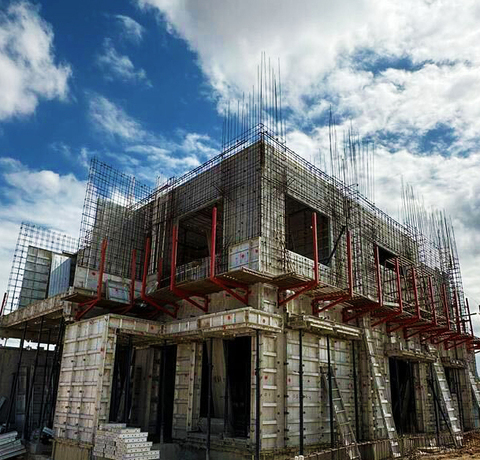
Alu-Form Technology is an advanced aluminium formwork system used for constructing monolithic reinforced concrete structures. Instead of building walls using bricks and mortar, this system casts entire walls, slabs, columns, and staircases in a single concrete pour using pre-engineered aluminium panels.

The result is a seamless, load-bearing structure that is stronger, faster to build, and highly precise.

Originally developed by a European company, the Alu-Form system has gained significant adoption in India, particularly in high-rise apartments, mass housing projects, and premium villa and apartment developments.


What is Formwork in Construction?

Formwork is a temporary mould used to hold freshly poured concrete in place until it gains sufficient strength to support itself.


It plays a critical role in determining:

  • Structural accuracy
  • Surface finish
  • Construction speed
  • Overall cost

Formwork alone can account for approximately 25–30% of total construction costs, depending on project complexity.

Types of Formwork Used in Construction

Several formwork systems are used in modern construction:

1. Timber Formwork

Traditional method using wood panels. Affordable but labour-intensive and less durable.

2. Fabric Formwork

Flexible sheets are used for curved or irregular shapes.

3. Plastic Formwork

Lightweight, reusable and modular.

4. Aluminium Formwork (Mivan System)

High strength-to-weight ratio, reusable up to 150–200 times.

5. Steel Formwork

Durable and suitable for heavy, repetitive use.

Among these, aluminium formwork offers the best balance of speed, precision and durability.

What is Modular Formwork?

Modular formwork refers to a construction approach that uses pre-engineered, standardised panels that fit together systematically.


Benefits include:


  • Up to 50% faster construction
  • Reduced on-site alterations
  • Lower labour dependency
  • Improved dimensional accuracy

What is the difference between Aluform and Mivan technology?

  • ‘Aluform’ refers to the aluminium forming process utilised in construction, much like ‘Mivan’, a company that pioneered this technology. Similar to how ‘Xerox’ is often used as a term for photocopying in India, both ‘Aluform’ and ‘Mivan’ are synonymous, representing the innovative construction method involving aluminium formwork.

Key Features of  Alu-Form Technology

1. Monolithic Structure

The entire structure is cast as a single concrete unit, increasing strength.

2. High Load-Bearing Capacity

Approximately 7–8 tonnes per sq.m, significantly higher than brick masonry.

3. Faster Construction Cycle

One floor can be completed in about 7 days.

4. Quick De-Shuttering

Vertical panels can be removed within 12 hours (after achieving the required strength).

5. High Reusability

Aluminium panels can be reused 150–200 times.

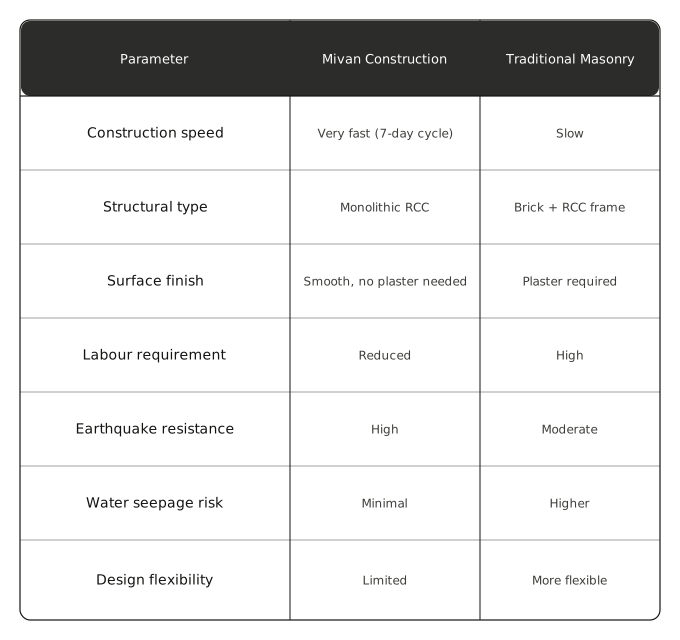
Alu-Form Construction vs Traditional Masonry

In Mivan construction, the formwork panels are well-made, ensuring consistent dimensions and a smooth concrete finish :

  • The technology uses pre-engineered aluminium form,s making each structure precise and accurate.

  • Concrete is mixed under strict quality control and delivered to the site.

  • Before pouring the concrete, the forms are set up with windows, doors, and frames.

  • This makes construction faster and more efficient.

  • The aluminium formwork is modular, making it easy to set up and remove.

  • After the formwork is removed, it does not require plaster, making the walls ready to be painted.


Traditional masonry makes use of bricks, stones and concrete blocks to construct walls and structures. :

  • This method is time-consuming and relies heavily on the skill of the mason.

  • In regions with high seismic activity, brick masonry is unsuitable.

  • A prerequisite step involves plastering the wall before it can be painted.

  • Absorption of water by bricks can lead to white depositions on the bricks known as efflorescence. This can affect both the appearance and the durability of the bricks.

    Time taken for construction

    The time taken for construction is higher because the set has to be done manually and the waiting period for curing is anywhere between 14 to 28 days.

    In this system, the walls and floor are molded together in one continuous operation in a matter of a few hours and the structure can be used within 3 to 7 days.

    Wastage

    Higher.

    Lesser than RCC/Brick wall.

    External Finishes

    Post construction extra time is required to plaster the wall before it can be painted.

    Once the walls are assembled, it can be painted directly.

    Maintenance


    High due to repairs in plaster of wall and ceiling. Repainting and leakages required due to plumbing installations.

    The walls and ceiling are of high quality concrete, so repairs for plastering and leakage are not required often.

    Advantages of Mivan Technology

    Lightning-Fast Construction

    Pre-engineered panels significantly reduce construction time.

    Smooth Finish

    Walls are smooth and ready for putty and paint without plastering.

    Structural Durability

    Monolithic RCC improves long-term performance and crack resistance.

    Earthquake Resistance

    A unified concrete structure performs better in seismic zones.

    Reduced Labour Cost

    Less dependency on large labour forces.

    Higher Carpet Area

    No plastering increases usable space.

    Reduced Pour Joints

    Minimises leakage risks.

    Sustainable Approach

    Reusable panels reduce material wastage.

    Disadvantages of Mivan Technology

    Despite its benefits, Mivan construction has certain limitations:

    High Initial Investment

    Formwork procurement and skilled training increase upfront cost.

    Limited Design Flexibility

    Late-stage design changes are difficult.

    Thermal Insulation Concerns

    Concrete structures may require additional insulation for energy efficiency.

    Skilled Labour Requirement

    Proper assembly requires trained professionals.

    Repair Complexity

    Damage to panels may require specialised replacement.


    Is Alu-Form Construction Earthquake-Resistant?

    Yes. Because Alu-Form buildings are cast as monolithic reinforced concrete structures, they perform better under seismic stress compared to conventional brick masonry buildings. This makes Mivan technology particularly suitable for earthquake-prone regions.


    What is the Lifespan of Alu-Form Buildings?

    Alu-Form buildings are known for their durability and low maintenance. With proper structural design and quality control, they can have a lifespan comparable to or exceeding traditional RCC structures. The reduced presence of joints and cracks contributes to long-term structural stability.


    Latest Advancements in Alu-Form Technology

    Modern innovations are enhancing Alu-Form construction further:

    • Integration with Building Information Modelling (BIM)
    • Robotics-assisted reinforcement placement
    • 3D printed formwork components
    • Advanced curing and monitoring sensors
    • Sustainability-focused material innovations

    These advancements improve accuracy, safety and efficiency.

    Final Thoughts: Is Alu-Form Technology the Future of Construction?

    Alu-Form Technology represents a major shift in how modern buildings are constructed. Its speed, structural strength and precision make it particularly suited for contemporary real estate demands. While it involves a higher initial investment and requires planning discipline, the long-term benefits in durability and efficiency make it a compelling choice for large-scale and premium developments.

    At Modern Spaaces, we are committed to integrating forward-thinking construction technologies to build homes that stand the test of time. If you would like to explore how advanced construction methods improve your home investment, connect with our team today.


FAQs (Frequently Asked Questions)


  1. What is Alu-Form / Mivan Technology used for?

    It is primarily used for high-rise apartments, villas, and mass housing projects.

  2. Is Alu-Form construction better than brick construction?

    It is accurate, more durable, and more earthquake-resistant, but offers less flexibility for design changes.

  3. Is Alu-Form construction expensive?

    Initial investment is higher, but long-term cost savings are achieved through speed and reduced labour.

  4. Does Alu-Form construction require plastering?

    No. The smooth finish eliminates the need for traditional plastering.

  5. How many times can Mivan formwork be reused?

    Approximately 150–200 times, depending on maintenance.
 

VIEW

Independent 4 & 5 BHK VillasIndependent 4 & 5 BHK Villas logo

Independent 4 & 5 BHK Villas

starts @ 4.5 Cr

UpArrow
Sarjapur’s Exclusive 3 BHK CommunitySarjapur’s Exclusive 3 BHK Community logo

Sarjapur’s Exclusive 3 BHK Community

starts @ 1.8 Cr

UpArrow
Multi-Gen 2 & 3 BHK HomesMulti-Gen 2 & 3 BHK Homes logo

Multi-Gen 2 & 3 BHK Homes

Starts @ 1.87 Cr

UpArrow

Refer & Earn
Up to 2%

Invite your friends to explore Modern Spaaces and earn up to 2% of the home value they buy.

Find your Dream Home. Let's talk

Tell us a bit about what you're looking for. One of us will get back to you!